Worldbuilding Resources for Story Settings
Worldbuilding resources for magic, culture, cities, governments, and setting conflicts that shape story choices.
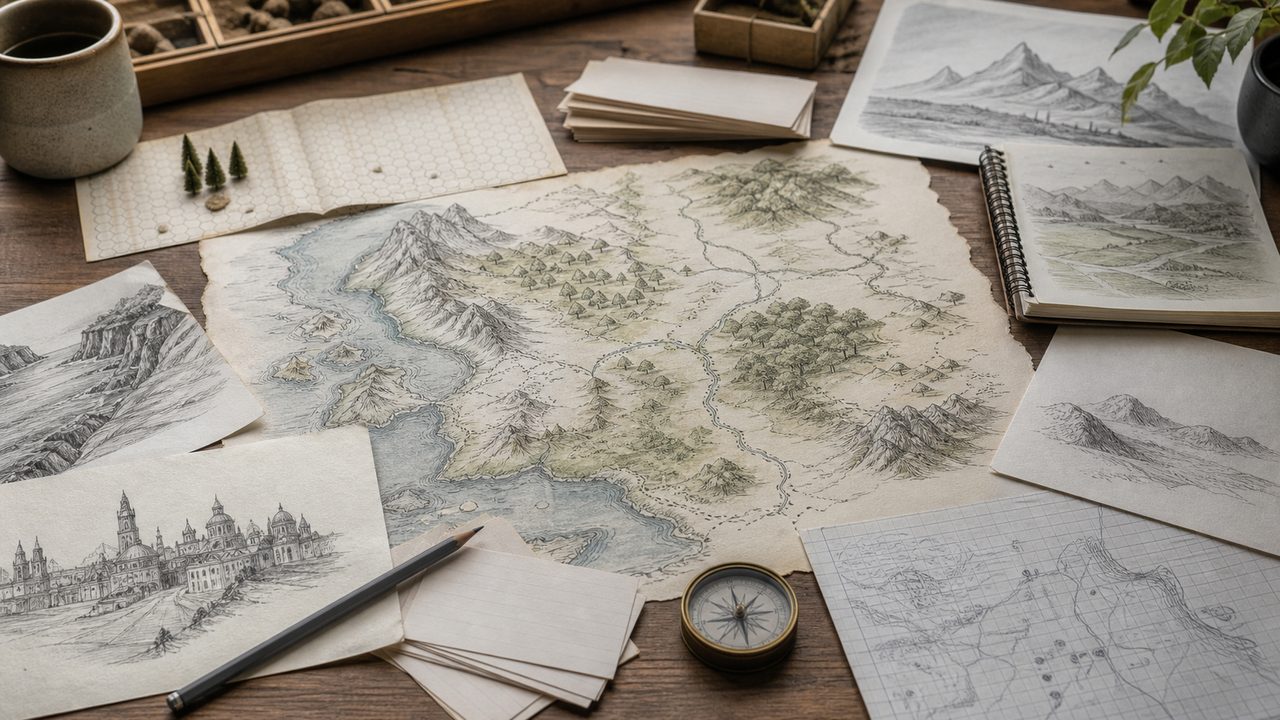
Worldbuilding is most useful when the setting makes choices harder. A calendar, map, law, custom, tool, shortage, or belief should create consequences for someone in the story.
If you arrived from the homepage, choose the setting problem first:
- Need a concrete place? Start with fantasy map planning questions if travel, borders, settlements, or distance are confusing; use city and town ideas or kingdom ideas when the local power center matters more than the route.
- Need social pressure? Use religion and myth prompts when belief, taboo, ritual, or sacred history changes what characters can do; use culture prompts, government prompts, or festival and tradition ideas for customs and institutions.
- Need practical constraints? Try economy prompts, geography prompts, technology level questions, sci-fi colony questions, or magic cost ideas.
- Need fictional history that still changes the present? Use the worldbuilding timeline worksheet before adding more eras, wars, rulers, or family trees.
- Need names, language, and everyday texture? Use naming and language prompts after you know who holds power, who has to adapt, and which names need to signal status, region, memory, or belonging.
- Need setting description that works inside scenes? Try setting description exercises after you know what the place changes for the character.
- Need a repair pass? Use setting conflict ideas and worldbuilding mistakes to avoid before adding more background.
If the setting still feels decorative
Use the newly refreshed support pages as a short diagnostic chain:
- Map pressure: fantasy map planning questions for routes, borders, distance, settlements, and impossible shortcuts.
- Language pressure: naming and language prompts for names, public labels, private speech, and who gets corrected.
- Belief pressure: religion and myth prompts for rituals, taboos, sacred stories, and consequences for breaking them.
- Scene pressure: setting description exercises for turning the chosen detail into action instead of explanation.
Build for use
For each detail, ask:
- Who benefits from this?
- Who is excluded by it?
- What happens when someone breaks the rule?
- How does this detail appear in an ordinary scene?
Start with one focused worksheet, then expand only the details your story actually touches. For a quick browser-only starting point, use the setting seed generator and then answer the four questions above.
Worldbuilding layers
Build from the part of the world the reader will touch first:
- Immediate scene: room, street, ship, village, workplace, border crossing, market, school, shrine, or road.
- Daily rule: what people must do, avoid, pay, hide, wear, carry, remember, or prove.
- Pressure system: law, weather, shortage, class, debt, language, belief, technology, distance, or tradition.
- Exception: who can bend the rule, who cannot, and what price follows.
This keeps setting detail close to character choice. A useful worldbuilding note should be able to enter a scene as an obstacle, habit, clue, custom, route, tool, or consequence.
Revision check
If a setting section reads like background, mark every detail with one of three labels: scene use, plot use, or cut. Details without use can stay in private notes, but the public story only needs the ones that create texture or pressure.
Outside worldbuilding references
For a second pass, compare your setting notes with a few external writing resources:
- National Centre for Writing: world-building in short stories on using world detail through character, language, clothes, technology, and belief.
- We Need Diverse Books: worldbuilding and consistent characters on making a fictional world feel lived-in and character-connected.
- Purdue OWL creative writing resources for broader fiction-writing and reading foundations.