Worldbuilding / guide
Naming and Language Prompts for Fictional Worlds
Naming and language prompts for writers who need fictional names, titles, dialects, sayings, and social conflict without building a full conlang.
Names and language carry history. You do not need a complete invented language to make a setting feel coherent, but you do need rules the reader can feel.
Pick the naming job
- If you need a character name, start with character name ideas and return here for cultural rules.
- If a name should reveal status, connect it to culture prompts or kingdom ideas.
- If speech patterns need to affect dialogue, pair this page with character voice exercises and narrative point of view.
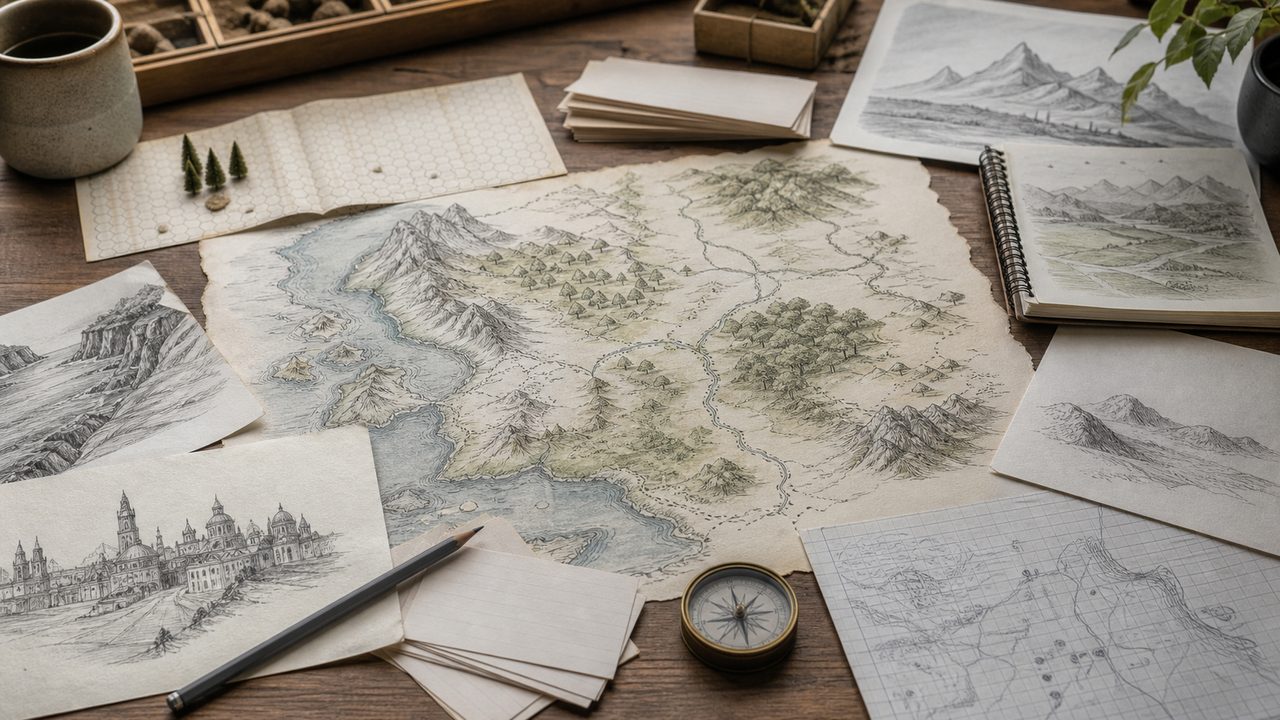
- If place names keep changing, mark the old and new names on your fantasy map before drafting the scene.
Naming prompts
- Which names are inherited, chosen, earned, bought, hidden, or forbidden?
- What title sounds polite in one region and insulting in another?
- Which profession leaves traces in family names?
- What nickname does a town give to outsiders who stay too long?
- What phrase means good luck but began as a warning?
- Who is allowed to use a ruler’s personal name?
- What old place name remains after the official map changes?
- Which name does a character refuse to answer to?
- What formal greeting takes too long during a crisis?
- What translation mistake causes a serious social problem?
- Which name is used only after someone dies?
- What polite phrase means “leave now” when spoken by elders?
- Which place name changes depending on who won the last war?
- What childish nickname becomes dangerous when said in public?
- Which title can be granted by a family but revoked by a court?
Language as conflict
- A character uses the old name for a city and reveals their politics.
- A treaty fails because two cultures use the same word for different kinds of promise.
- A servant understands a formal dialect the nobles assume is private.
- A traveler gives the correct greeting at the wrong level of intimacy.
- A family name opens doors in one district and closes them in another.
Pattern examples
- Trade towns might favor short practical names, while old courts preserve long titles.
- Border regions might mix naming customs and treat pronunciation as a loyalty test.
- Religious communities might avoid naming children after the living.
- Military settlements might turn ranks, tools, or victories into surnames.
Consistency rule
Pick two naming patterns and repeat them lightly. Too many invented syllables can blur together; a few clear customs do more work.
Repair route
If the language layer feels random, do a short pass:
- Choose one naming rule for family, one for place, and one for formal address.
- Put those rules on the character profile worksheet for two major characters.
- Write one scene planning note where using the wrong name changes trust, access, or danger.
- Cut invented words that do not change meaning, relationship, or pressure.