Worldbuilding Mistakes to Avoid
Common worldbuilding mistakes and practical fixes for settings that need to shape plot, character, culture, and consequence.
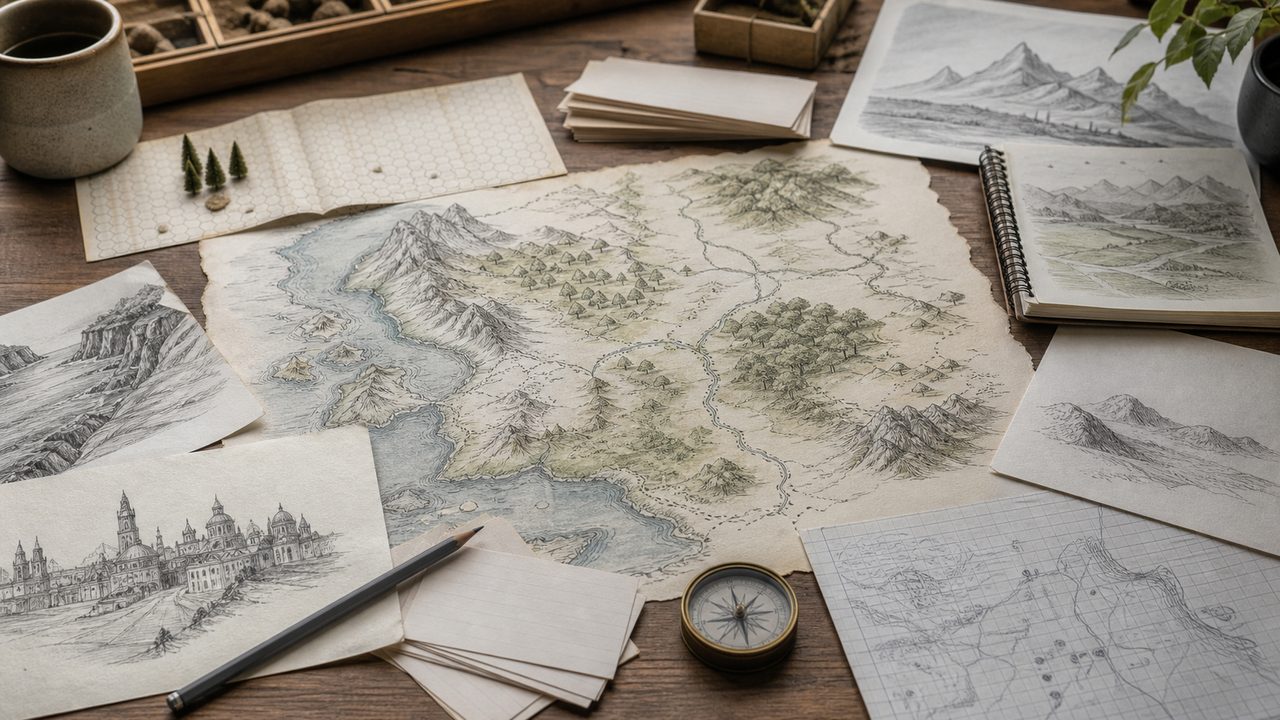
Worldbuilding goes flat when details exist only to prove that the world is large. The fix is not always more lore. Often it is clearer consequence.
Mistake: every detail has the same weight
If every holiday, law, map feature, and historical event gets equal attention, readers cannot tell what matters.
Fix: choose three setting details that directly affect the protagonist’s choices. Let the rest appear only when needed.
Mistake: culture has customs but no cost
A custom becomes story material when it rewards someone, excludes someone, or creates a hard choice.
Fix: for every custom, answer who benefits, who obeys publicly but resents it privately, and what happens when someone breaks it.
Mistake: geography is decorative
Maps can look interesting while doing nothing to the plot.
Fix: make distance, climate, borders, routes, or isolation change what characters can attempt. A mountain range should affect travel, trade, secrecy, or power.
Mistake: the magic or technology has no limits
Unlimited systems remove suspense because any problem can be solved by a new ability or device.
Fix: define cost, access, failure, training, maintenance, social rules, and unintended effects.
Mistake: history replaces present conflict
A long history can become a lecture if it does not create present danger, loyalty, shame, pride, or misunderstanding.
Fix: turn one historical event into a living dispute. Different groups should remember it differently.
Mistake: everyone in a group thinks alike
Cultures, guilds, families, and governments feel artificial when every member agrees.
Fix: add internal disagreement. Give insiders different ages, jobs, status, fears, and reasons for supporting or resisting the same rule.
Mistake: names replace relationships
Invented titles, regions, factions, and institutions can sound complete while hiding the fact that no one on the page wants anything from anyone else.
Fix: connect each named group to a relationship. Who pays them, fears them, needs their approval, ignores their law, or remembers what they did?
Mistake: the world never interrupts the scene
If the setting only appears in description blocks, readers may admire the backdrop without feeling it.
Fix: make the world interrupt an action. A rule delays a meeting, a route closes, a ritual changes the timing, a tool fails, a border forces a lie, or a local custom makes a simple request risky.
Quick revision pass
Choose one world detail and write:
- The public version.
- The private cost.
- The person who benefits.
- The person who is trapped.
- The scene where the detail forces a choice.
One-page audit
Before adding more lore, audit one chapter:
- Which world detail changes a decision in the scene?
- Which detail creates a cost for the viewpoint character?
- Which detail reveals social status without explanation?
- Which detail could be removed with no story effect?
- Which detail should return later as pressure, clue, or contrast?