Why the USMNT World Cup Breakthrough Feels Like a Belief Story
A source-backed Story Craft breakdown of the USMNT win over Bosnia-Herzegovina, the red card, the Tillman free kick, and why breakthrough stories grip audiences.
The U.S. men’s national team beat Bosnia-Herzegovina 2-0 on July 1, 2026, and the result quickly became more than a scoreline. It was a home World Cup knockout win, a red-card survival test, a Malik Tillman free kick, and a setup for Belgium that immediately summoned older U.S. soccer memories.
July 6 update: the Belgium setup now has a sharper follow-up angle because Folarin Balogun’s one-match suspension was deferred before USA vs Belgium in Seattle. Read the companion page on USA vs Belgium eligibility pressure when you want the rule-decision, fairness, and legitimacy layer that arrived after this breakthrough win.
That makes it useful for Story Draft Lab because this is not only a sports result. It is a clean example of a breakthrough story: a group carries old baggage into a public test, suffers a visible setback, and then wins in a way that lets fans update what they believe the group is allowed to become.
U.S. Soccer’s match recap says the USMNT advanced with a 2-0 shutout, with Folarin Balogun scoring before halftime and Tillman adding a free kick after the team went down to 10 men. ESPN and ABC also framed the result around the first U.S. men’s World Cup knockout win since 2002. The next round adds another story layer: Belgium, the team that eliminated the U.S. in 2014, waits in Seattle.
Why this hit has a different shape
The recent Germany-Paraguay pages on this site are about an upset and a disputed ending. The USMNT win gives the World Cup cluster a different emotional lane: belief repair.
Belief repair is not the same as celebration. A team, family, company, kingdom, crew, class, or friendship group can win many small moments without changing how people talk about it. A breakthrough changes the story people use before the next test begins.
That is why the red card matters narratively. Without it, the result is cleaner. With it, the audience gets a stress test: can this group still protect the lead, stay organized, and create one more decisive moment after the plan breaks?
The breakthrough engine
Breakthrough stories usually need four moving parts:
The last part is easy to miss. A breakthrough story should not end by pretending all doubt has vanished. It works better when the win changes the question.
Before Bosnia-Herzegovina, the question was whether the U.S. could win a knockout match again. After Bosnia-Herzegovina, the question becomes whether this changed version of the team can carry that proof into a deeper test. That shift gives fans permission to imagine more without making the story feel finished.
Why audiences love proof under disadvantage
Audiences often trust a breakthrough more when it happens under disadvantage. The disadvantage acts like a truth serum. It strips away the easy explanation that the character, team, or group only looked strong because everything went smoothly.
For fiction writers, the pattern is portable:
- Give the group a public history of almost, not yet, or not since.
- Let the first half of the scene appear to confirm progress.
- Break the plan in a way everyone can see.
- Force someone besides the expected hero to supply the decisive proof.
- Leave a next opponent, deadline, gatekeeper, or memory waiting.
Tillman’s free kick is useful in craft terms because it is both specific and symbolic. It is a technical action inside the match, but it also becomes a story object: a second goal while short-handed, scored by a player who steps into the pressure after the forward who opened the scoring is gone.
How to use this in character work
Breakthrough arcs are strongest when the character is not merely trying to win. They are trying to change the story around themselves.
Use this shape for:
- A student who has always been treated as talented but fragile.
- A startup team that loses its lead engineer before a demo.
- A fantasy patrol that survives after the obvious champion is removed.
- A family that has avoided one old disaster for years and finally faces a repeat.
- A detective partner, apprentice, or side character who has to supply the proof when the usual lead cannot.
The important move is to make belief public. Someone must witness the setback. Someone must know the history. Someone must be able to say, after the moment, that the old label no longer fits cleanly.
Pair this with character growth prompts when a person needs proof of change, story stakes ideas when the scene needs a public cost, and scene planning when a victory needs a sharper turn.
Add it to the World Cup story cluster
The site’s World Cup cluster now has three useful search-and-story lanes:
Image plan and screening
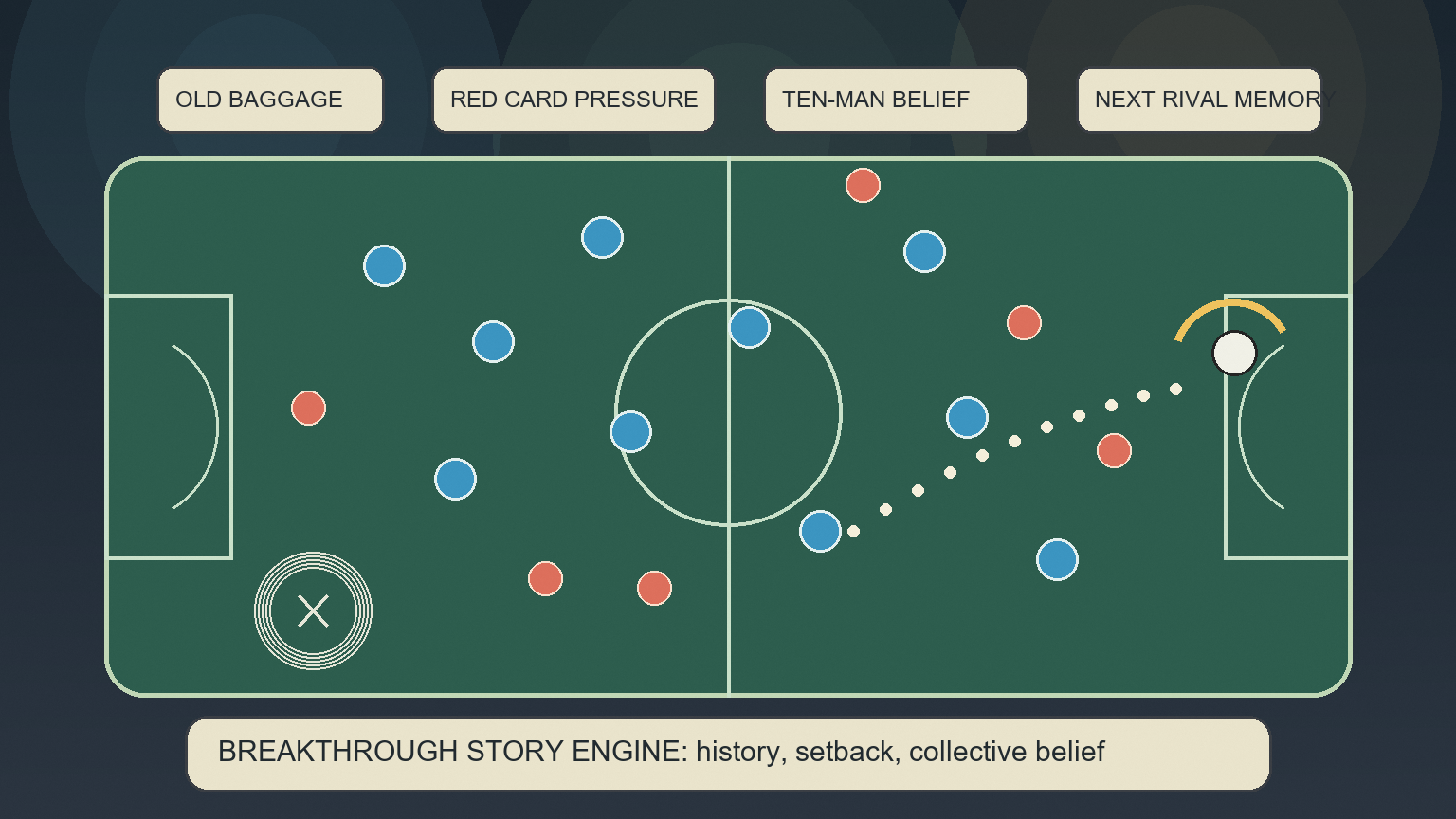
Chosen image job: explain the breakthrough as a symbolic tactics-and-story board rather than copy live match imagery.
Candidate screening:
- Rejected match photos, Reuters/AP/Getty/news images, broadcast frames, highlights thumbnails, social screenshots, player portraits, team crests, flags, FIFA/World Cup marks, federation logos, and watermarked images for local use.
- Rejected official and social-video stills because they depend on player likenesses, TV footage, platform marks, or uncertain reuse rights.
- Accepted a self-made PNG because it is article-specific, raster, symbolic, and non-watermarked. It uses generic colored player dots, a field board, a missing-player mark, a free-kick arc, and story cards. It contains no real people, national symbols, official marks, copied broadcast composition, readable third-party text, or paid-stock preview material.
Risks to avoid
Do not turn this pattern into empty destiny language. A breakthrough story needs evidence, not just belief. The July 1 match works as a story model because the proof is visible: a lead, a red card, a short-handed shape, and a second goal under pressure.
In fiction, the weak version declares that the group has changed. The stronger version makes the audience watch the group behave differently when the old problem returns.
Sources
- U.S. Soccer: match recap and highlights for USMNT 2-0 Bosnia-Herzegovina
- ESPN: USA 2-0 Bosnia-Herzegovina game analysis
- ESPN: USMNT beats Bosnia-Herzegovina for first World Cup knockout win since 2002
- ABC News: U.S. defeats Bosnia-Herzegovina 2-0 and advances
- Opta Analyst: USA 2-0 Bosnia-Herzegovina stats and Tillman free-kick note