Why Paraguay's Penalty Upset Feels Like a Perfect Underdog Story
A source-backed Story Craft breakdown of Paraguay beating Germany on penalties at the 2026 World Cup, and why underdog pressure hooks audiences.
Paraguay beating Germany on penalties at the 2026 World Cup is built for more than a sports headline. It has the shape of a clean public story: a heavy favorite, a smaller nation, a long match that refused to resolve, and a final test where one kick can rewrite everyone’s memory.
Associated Press coverage of the June 29 match reported that Paraguay beat Germany 4-3 on penalties after a 1-1 draw, with Jose Canale scoring the sudden-death penalty and goalkeeper Orlando Gill making two key saves. AP and local carriers framed it as the biggest upset of this World Cup so far. That language matters because the crowd did not only watch a result. It watched expectation collapse.
That is the Story Draft Lab angle. Penalty shootouts turn team sport into character theater. The bigger the favorite, the more the audience feels that every small action has moral weight.
Why this result spread
A World Cup upset travels because it gives casual viewers a simple emotional sentence: “The team that was supposed to lose survived the exact test that should have exposed them.” You do not need to know every formation or club career to understand that shape.
The match also had a built-in contrast. Search results and pre-match betting previews showed Germany treated as the safer pick, while post-match AP coverage emphasized Paraguay’s long-shot status and Germany’s latest early exit after its 2014 title. That before-and-after swing is what makes an upset sticky. The audience gets two stories for the price of one: the underdog’s breakthrough and the favorite’s loss of certainty.
Penalties make character visible
Most stories need a way to make inner pressure visible. Penalties do that almost too well. The player walks alone. The goalkeeper waits alone. The team becomes a line of witnesses. The audience has enough time to imagine fear before the action happens.
That is why shootouts feel different from ordinary goals. In open play, a mistake can be blamed on movement, timing, teammates, tactics, or luck. In a penalty, the frame narrows until the viewer feels invited to judge nerve, preparation, courage, hesitation, and fate.
Writers can borrow the shape without copying soccer. The key is not the kick. The key is a public, irreversible action after a long period of pressure.
The underdog hook is not only victory
The emotional reward of an underdog story is not simply that a smaller side wins. It is that the win appears to reveal something that was hidden: unity, preparation, stubbornness, or belief that outsiders had not priced correctly.
That is why post-match images of celebration matter, even when you do not use them as article art. AP described public celebration in Asuncion, including people hugging, crying, and reacting in disbelief. The fact pattern is useful because it shows how a game result becomes social identity. The story leaves the field and becomes a citywide proof of belonging.
For fiction, that means the best underdog moments should change the room around the character. A private win is satisfying. A public win that lets a whole group reinterpret itself is much louder.
What writers can borrow
Use the Paraguay-Germany penalty structure when you need a scene that turns pressure into identity.
- Give the favorite a visible reason to be trusted. Reputation creates the expectation that later collapses.
- Let the underdog survive long enough for doubt to spread. A sudden upset can feel random; a resisted favorite feels earned.
- Narrow the ending to one action. A vote, confession, audition, choice, shot, signature, or apology can function like the penalty spot.
- Put witnesses in the frame. Pressure becomes story when someone important cannot intervene.
- Make the aftermath communal. Show how the result changes what a family, team, town, fanbase, or workplace believes about itself.
For follow-through, pair this pattern with the companion Germany-Paraguay VAR controversy breakdown when the ending needs a disputed authority figure, story stakes ideas when the scene needs sharper consequences, character conflict ideas when the opposition feels too abstract, and ending ideas when the final action needs payoff instead of noise. If you want to stage the pressure beat, use the scene planning worksheet and define the witness, object, decision, and point of no return.
Image plan and screening
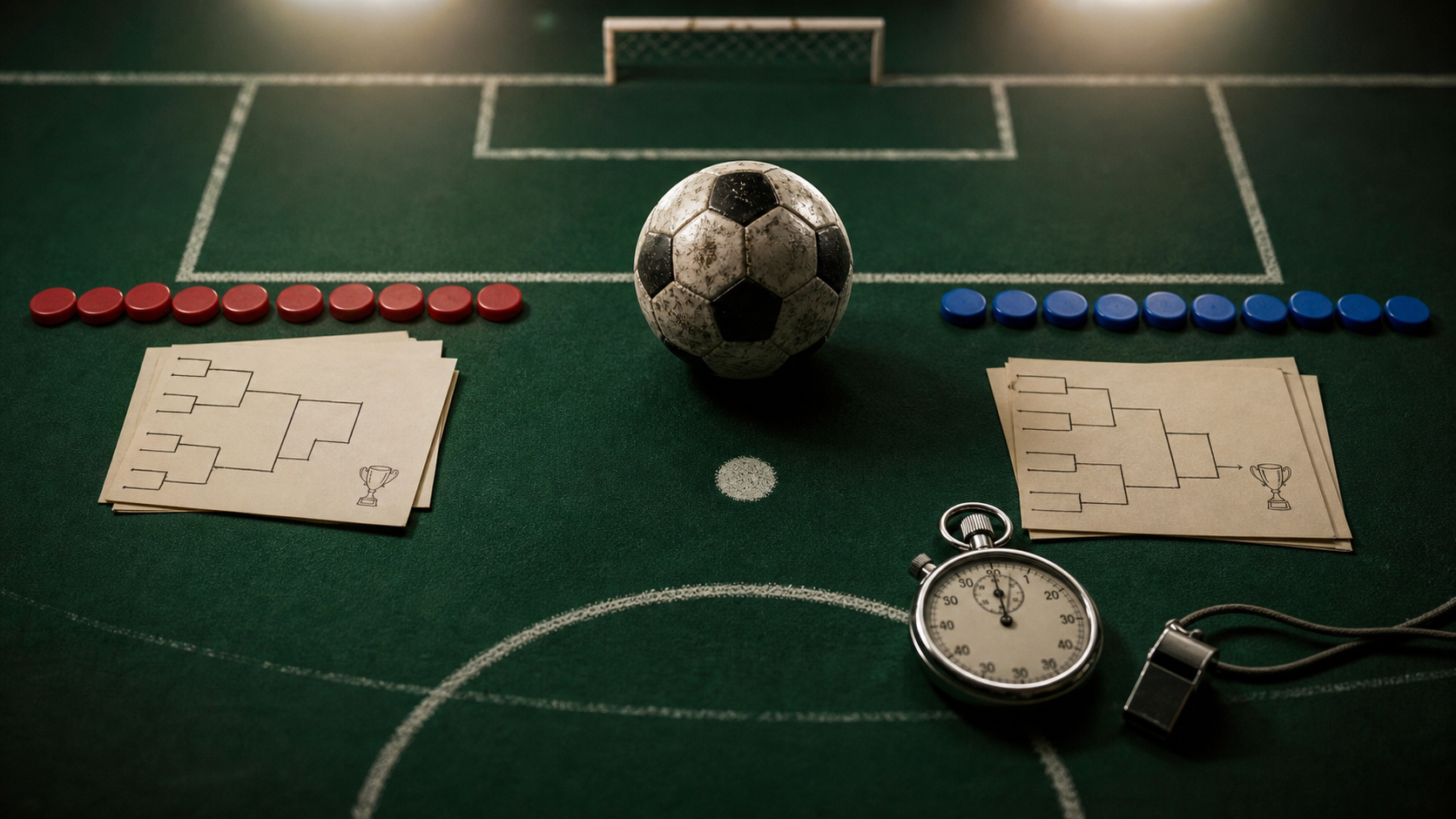
Chosen image job: explain penalty-shootout pressure and underdog brackets through a safe symbolic sports still life.
Screening notes:
- Rejected AP, Getty, news-site, and social images because they show real players, match photos, or unclear local reuse rights.
- Rejected team crests, flags, broadcast screenshots, and official World Cup/FIFA marks because they add avoidable logo and rights risk.
- Selected an original generated PNG showing a generic soccer tactics table, ball, brackets, stopwatch, and color-coded magnets. It contains no player likenesses, flags, team logos, brand marks, watermarks, or copied match imagery.
Risks to avoid
The cheap version of an underdog scene is destiny talk. The stronger version shows what the underdog actually did under pressure: endured, prepared, adapted, and stayed readable when the room expected collapse.
There is also a sports-writing risk. Do not turn a craft page into betting advice, tactical certainty, or national stereotype. The useful material is the audience mechanism: how public expectation, isolation, witnesses, and one irreversible action make a result feel like a story.
Sources
- Associated Press via WSLS: Paraguay stuns Germany in a penalty shootout
- Associated Press via Boston Herald: Paraguay beats Germany 4-3 in penalty shootout
- theScore: Germany and Paraguay went to the first shootout of the 2026 World Cup
- Canada Sports Betting: pre-match favorite framing for Germany vs. Paraguay