Why USA vs Belgium Became an Eligibility Pressure Story
A source-backed Story Craft breakdown of USA vs Belgium, Folarin Balogun's deferred suspension, the Belgium rematch, and how legitimacy pressure changes a scene.
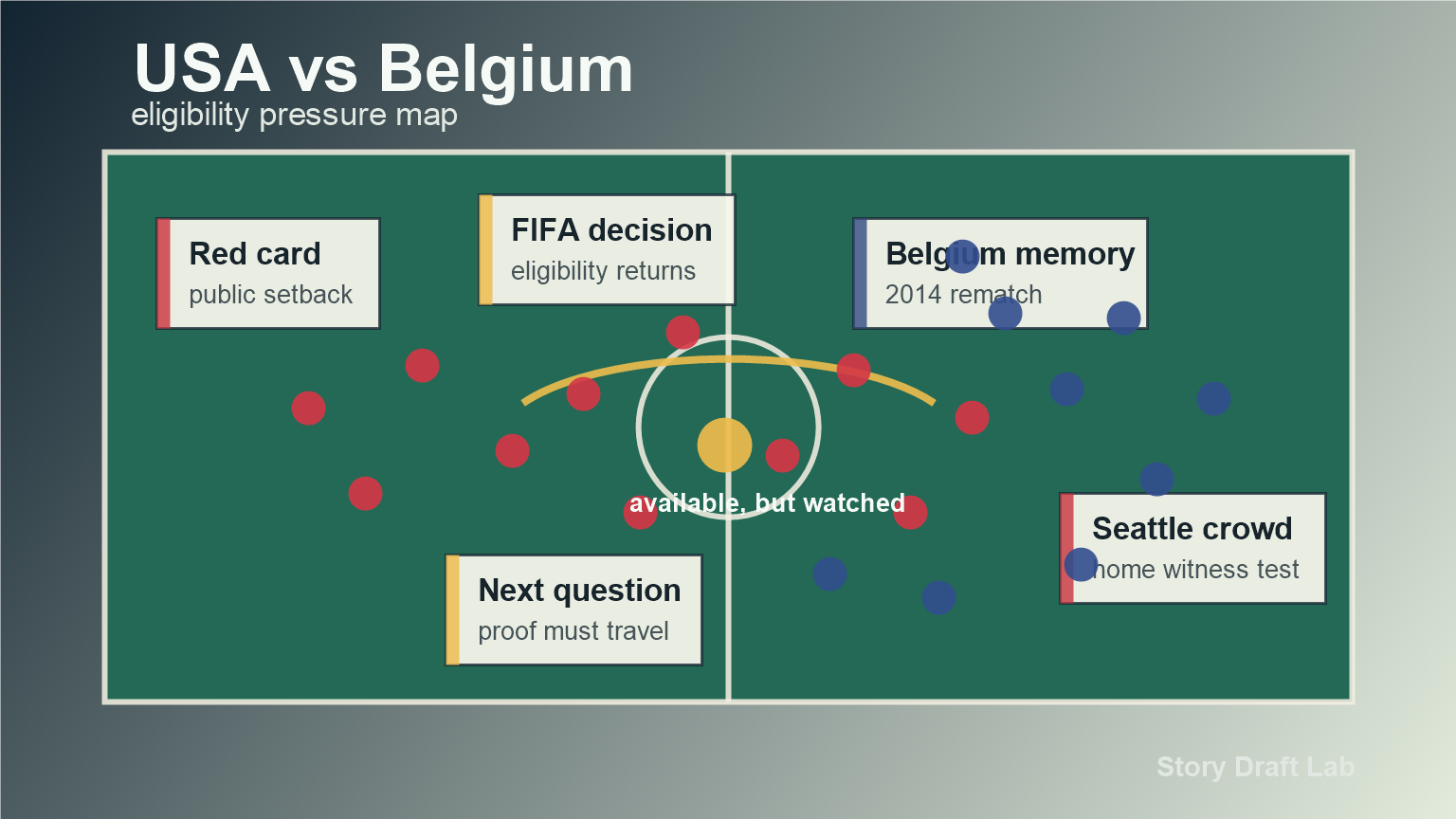
USA vs Belgium was already a clean World Cup search hook: a July 6, 2026 Round of 16 match in Seattle, a U.S. home-tournament pressure test, and a rematch shadow from 2014. Then Folarin Balogun’s red-card suspension was deferred, making the story bigger than team news.
That is why this is useful for Story Draft Lab. The live hook is not only whether Balogun can play. It is how an eligibility decision changes the emotional weather around a scene. The hero returns, the rival questions fairness, the crowd gets louder, and the next result will be judged through a new frame.
U.S. Soccer says Balogun, the USMNT’s leading scorer at this World Cup, is available for selection against Belgium after FIFA suspended implementation of his one-match ban for a one-year probationary period. U.S. Soccer also lists the match for Monday, July 6 at 5 p.m. PT / 8 p.m. ET in Seattle. Axios reports that Belgian officials were “astonished” by the decision and were exploring options, while FOX’s matchup preview keeps the older story layer in view: Belgium eliminated the U.S. in the 2014 Round of 16.
Why eligibility pressure travels
Sports audiences understand a simple injury update. They understand a simple suspension. What spreads harder is a ruling that changes who is allowed into the scene after everyone has already started imagining the scene without him.
That kind of update creates four simultaneous stories:
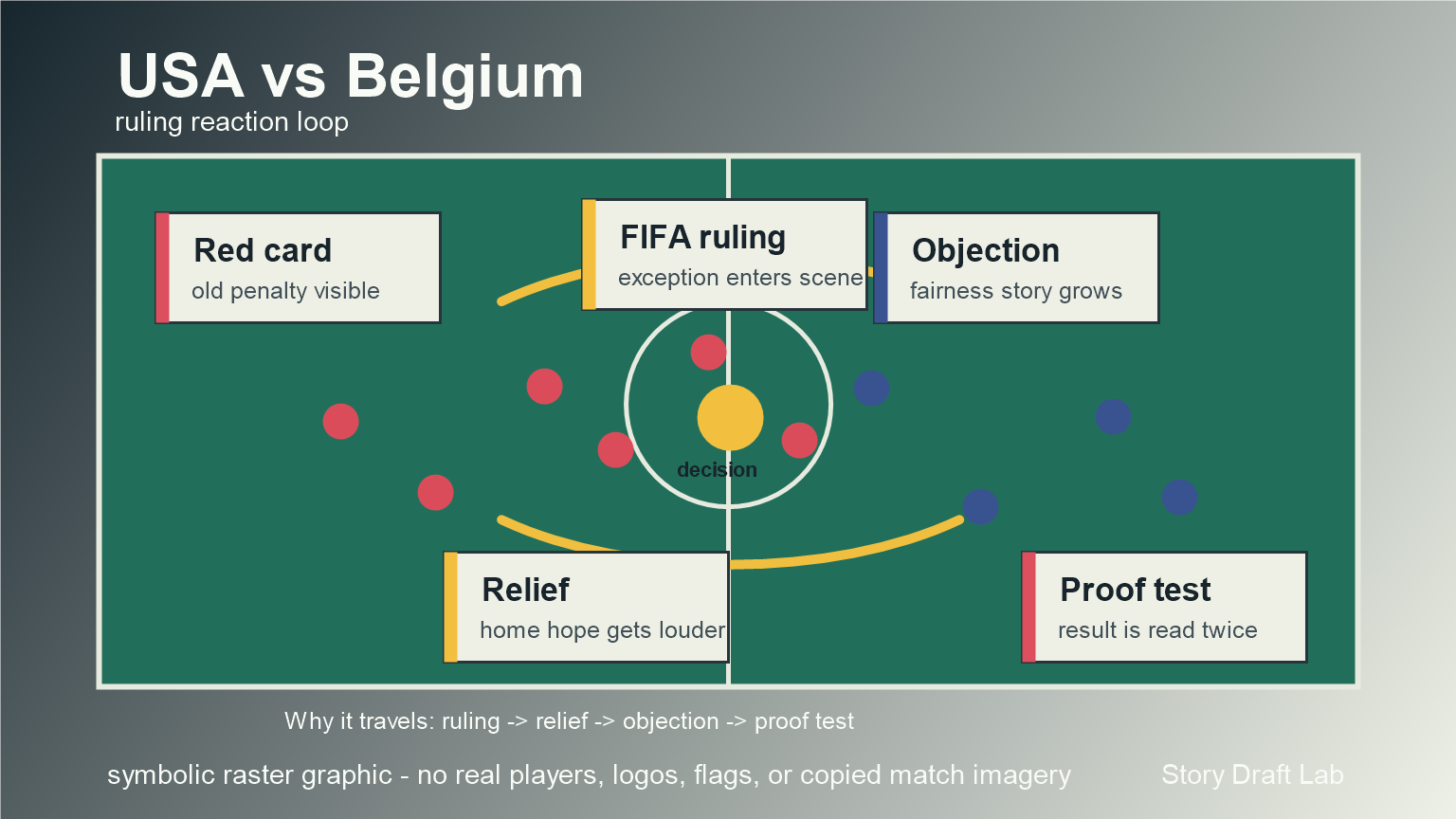
The second loop is why this page works better as an evening search update than as a plain match preview. A preview asks who might win. A ruling-reaction story asks what the crowd will do with the result after the exception has already changed the room.
The last point matters. A ruling does not automatically make a story bigger. It becomes bigger when it attaches to an existing emotional account: an old rival, a public loss, a home crowd, a player carrying scoring proof, or a group trying to change its reputation.
The craft lesson under the news
Eligibility pressure is a useful fiction tool because it changes what the audience is measuring.
Before the ruling, the audience asks: can the group survive without the missing person?
After the ruling, the audience asks: can the group use the returned person without making the victory feel compromised?
That is a sharper question. It means the player, character, witness, or ally is no longer just helpful. They become a legitimacy test. Every touch, choice, mistake, and reaction is read twice: once for plot function, and once for whether the story has earned the exception.
Use this shape when a scene needs more than ordinary suspense:
- A banned heir receives a temporary pardon before a public trial.
- A star witness is allowed to testify after a disputed procedural ruling.
- A disgraced pilot returns for one emergency flight while the rival crew watches.
- A magical law bends for one character, but the cost remains active for a year.
- A student gets reinstated before the final debate and must win without looking protected.
The trick is not to ask the audience to forget the earlier penalty. Keep it visible. The red card, suspension, pardon, appeal, waiver, or exception should stay in the room as pressure, not disappear as paperwork.
How this strengthens the USMNT cluster
The existing USMNT breakthrough page explains the July 1 Bosnia-Herzegovina win as belief repair: old baggage, a visible setback, and proof under disadvantage. This page adds the July 6 follow-up angle: what happens when a procedural decision reopens the story before the next opponent arrives.
That also makes it a companion to the site’s VAR controversy page. Both articles are about more than a call. They are about authority, evidence, fairness, and why audiences keep arguing after the official decision is made.
For writers, pair this with story theme questions when the scene needs a moral argument, character growth prompts when the returned character must prove change, and scene planning when a public test needs witnesses, stakes, and a second verdict.
Image plan and screening
Chosen image job: explain USA vs Belgium as an eligibility-pressure mechanism, not as a copied match photo.
Candidate screening:
- Searched for USA vs Belgium, Balogun red-card suspension, and Seattle Round of 16 imagery.
- Rejected news/wire photos, red-card frames, player portraits, team crests, jerseys, FIFA/World Cup marks, broadcast stills, social screenshots, watermarked images, paid-stock-style previews, and generic soccer images that did not explain the eligibility mechanism.
- Rejected the visually strong player/photo candidates because they depend on real athlete likeness, federation marks, news-photo licensing, or unclear reuse rights.
- Accepted two self-made PNGs because they are article-specific, raster, symbolic, non-watermarked, and contain no real people, national symbols, official marks, sponsor marks, copied broadcast composition, third-party imagery, or logos. The evening-added reaction-loop graphic passed the content-match check because it explains how the same ruling becomes relief, objection, and proof pressure.
Risks to avoid
Do not frame a disciplinary ruling as proof of corruption unless a source proves it. The useful story angle is narrower and safer: a public eligibility decision changes the pressure around a match because different audiences read the same ruling as relief, fairness problem, or proof test.
In fiction, that is enough. You do not need a conspiracy. You need a visible exception, a rival who cares, witnesses who remember the old problem, and a result that now has to answer two questions at once.
Sources
- U.S. Soccer: Folarin Balogun available for selection against Belgium
- U.S. Soccer: USMNT vs Belgium opponent profile, date, venue, and history
- Axios: FIFA clears Balogun for USMNT’s Belgium match
- The Guardian: UEFA and Belgium criticism of FIFA’s Balogun ruling
- FOX Sports: USA vs Belgium Round of 16 matchup history and schedule