Why Spain's 3-0 World Cup Win Feels Like Confidence Returning
A source-backed Story Craft breakdown of Spain beating Austria 3-0 at the 2026 World Cup, and why visible control can revive a stalled public story.
Spain’s 3-0 World Cup win over Austria on July 2, 2026, has a clean headline hook: Mikel Oyarzabal scored twice, Pedro Porro added another, and Spain reached the last 16 with its first World Cup knockout win since the 2010 final.
The more useful Story Draft Lab angle is confidence returning in public. A team can have talent, trophies, possession, and reputation, but audiences still ask whether the old spell works under knockout pressure. Spain’s win changed the question. It was no longer only “are they still convincing?” It became “what happens when control becomes visible again?”
That is a strong craft pattern. Some characters do not need a surprise transformation. They need a proof scene where everyone finally sees the competence that had been doubted.
Why this trend has traffic energy
Current coverage gives the page a clear search lane. AP reported Spain’s 3-0 win, Oyarzabal’s brace, Porro’s goal, Unai Simon’s extended shutout run, and the next match against Portugal. FIFA’s match report also framed the result as Spain overrunning Austria and setting up the Portugal-or-Croatia path. ESPN’s live and feature coverage emphasized the first Spain World Cup knockout win since 2010.
That “since 2010” detail is why the story travels beyond one scoreline. It turns a result into a before-and-after marker. Spain was not only beating Austria. Spain was answering a question that had followed the national-team story through several World Cups: can the modern version turn control into knockout authority?
For writers, that is the difference between a win and a credibility reset.
The confidence-return engine
Use this pattern when a character has a strong reputation but the room no longer trusts the reputation by itself.
The visible-proof step matters most. If the story only says “they are back,” the reader has to accept the narrator’s verdict. If the scene shows pressure absorbed, chances created, mistakes contained, and the scoreboard moving, the audience feels the conclusion arrive on its own.
Why dominance can be dramatic
Writers often assume drama needs chaos. Sometimes it does. But dominance can be dramatic when the audience arrives with doubt.
A character who controls a room after three chapters of hesitation can create more tension than a character who wins a messy argument by accident. The tension shifts from “will they survive?” to “is this the old version returning, or a new version finally stabilizing?”
Spain’s result offers that shape. AP described Austria as finishing without a shot on target, while Spain combined attacking output with defensive control. That gives the story two kinds of proof: not only goals, but the absence of panic.
In fiction, this can look like:
- A lawyer who has been losing confidence delivering a quiet cross-examination that leaves the room no escape.
- A former champion returning from injury and winning without theatrics.
- A ruler who stops a crisis by making three precise decisions before rivals realize the game has changed.
- A band that has become a nostalgia act playing one new song so well the crowd stops waiting for the old hit.
- A student dismissed as gifted-but-soft completing the hardest practical test with no visible wobble.
The trick is to make control active. Show choices, timing, restraint, and consequences. Calm only reads as power when the scene proves something could have gone wrong.
Why Portugal next sharpens the page
Spain’s next confirmed opponent is Portugal, which beat Croatia 2-1 after Cristiano Ronaldo’s equalizer and Goncalo Ramos’s stoppage-time winner. That gives the World Cup cluster a useful contrast.
The Portugal page is a legacy-handoff story: an aging icon gets partial closure, then a successor finishes the scene. The Spain page is a confidence-return story: a strong system reclaims trust by making control visible.
Those are different pressures:
That makes the July 6 Spain-Portugal matchup easy to explain for casual readers: it is not only a rivalry fixture. It is two different story engines colliding.
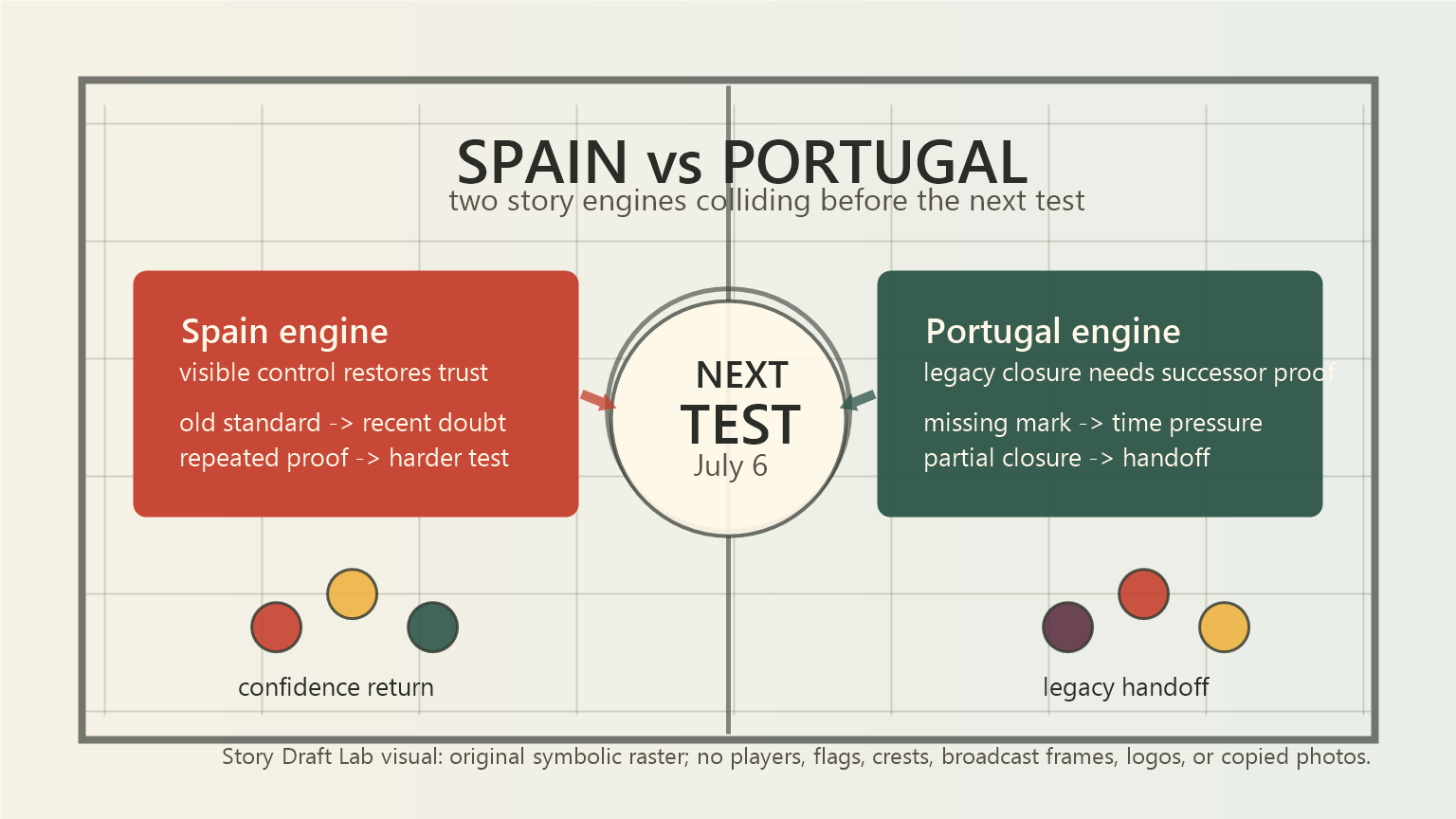
FIFA’s July 3 roundup sharpened that collision by pairing Lamine Yamal and Mikel Oyarzabal’s Spain performance with Cristiano Ronaldo and Goncalo Ramos pushing Portugal through. FOX’s same-day roundup also framed Portugal’s win as dramatic and noted Ronaldo was on the bench by the end. That is exactly the kind of contrast a traffic page can use without becoming prediction content: the search hook is the matchup, but the evergreen value is the story-pattern contrast.
What writers can borrow
Use a confidence-return scene when a character is skilled but the audience has a reason to doubt the skill still works.
- Give the character an old standard. The reader should know what “back” would mean.
- Name the source of doubt. A recent loss, injury, betrayal, failed test, or public embarrassment keeps the scene from feeling like easy praise.
- Make the proof repeat. One lucky moment is relief; repeated control is credibility.
- Let quiet competence count. Not every restoration needs a speech, explosion, or confession.
- End with a harder next question. Confidence that returns should immediately attract a bigger test.
For follow-through, pair this page with the Portugal legacy-handoff breakdown for the upcoming rivalry contrast, the USMNT belief-repair page for a group-doubt version, story stakes ideas for external pressure, and character growth prompts when the proof scene needs a personal cost.
Image plan and screening
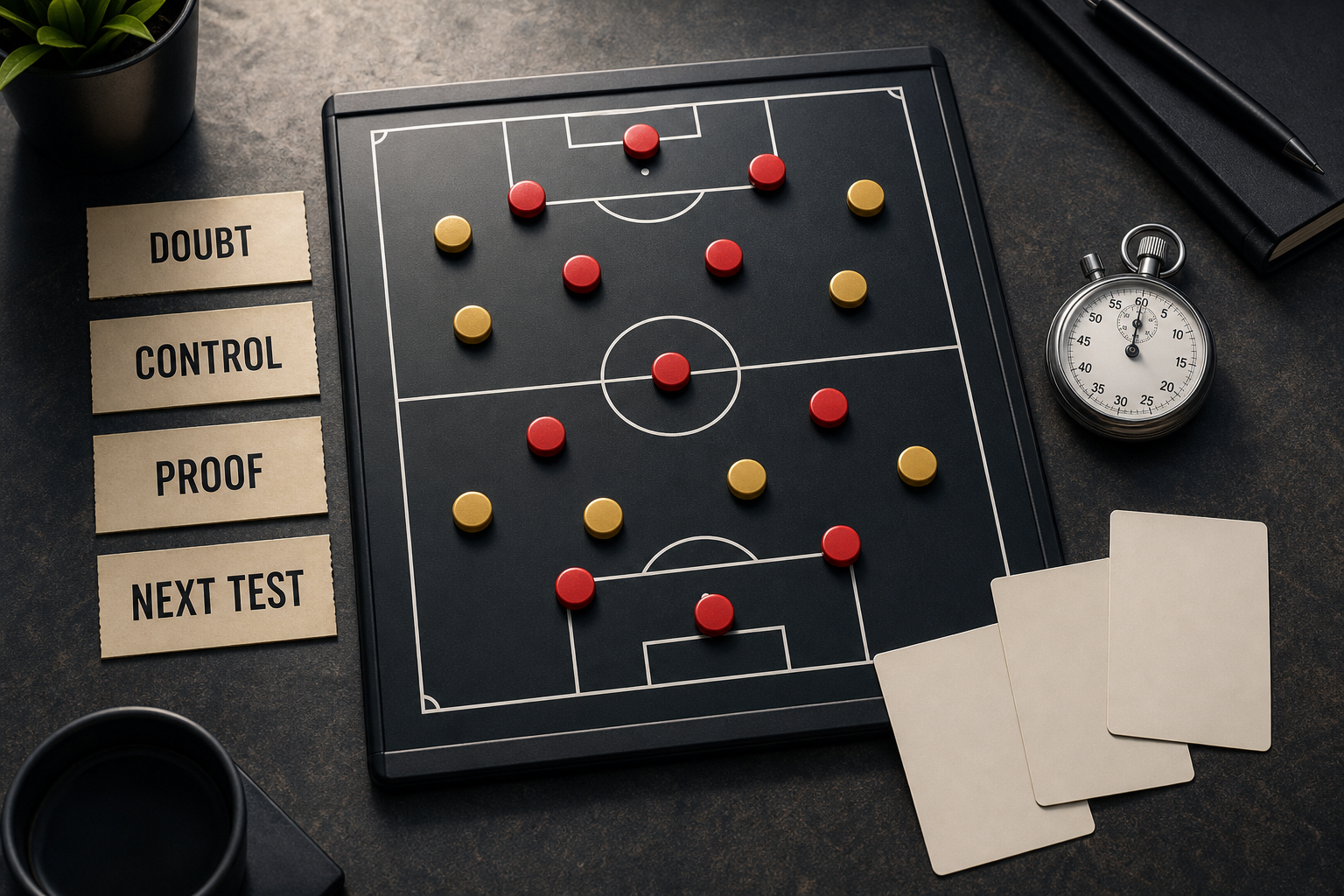
Chosen image job: explain Spain’s win as a symbolic tactics-and-story board about doubt, control, proof, and the next test.
Candidate screening:
- Rejected match photos, AP/news images, FIFA highlight images, broadcast frames, player portraits, team crests, flags, stadium signage, sponsor boards, social screenshots, and watermarked or paid-stock preview images for local article use.
- Rejected official sports imagery even when relevant because it carries avoidable likeness, logo, event-mark, and local-copy reuse risk.
- Accepted a self-made raster PNG because it is article-specific, symbolic, and neutral. It uses generic football-board objects and abstract markers rather than real players, national symbols, official marks, copied match composition, readable third-party text, or watermarks.
- Added a second self-made raster PNG for the Spain-Portugal matchup contrast. It passed the same filter: no real players, faces, flags, crests, FIFA marks, sponsor boards, copied photos, broadcast frames, logos, watermarks, or paid-stock preview material.
Risks to avoid
Do not turn a confidence-return story into a victory lap with no friction. The audience only feels restoration if doubt had a real reason to exist.
Also avoid making the page tactical certainty or sports prediction. The useful material is narrative psychology: how visible control changes what people believe about a character, team, or group before the next test arrives.
Sources
- Associated Press: Spain beats Austria 3-0, Oyarzabal scores twice, and Portugal is next
- FIFA: Spain 3-0 Austria match report and highlights
- ESPN: Spain 3-0 Austria live/result coverage
- ESPN: Spain’s first World Cup knockout win since the 2010 final
- FOX Sports: Portugal’s next opponent is Spain after the Croatia win
- FIFA: Yamal and Ronaldo help set up Portugal-Spain
- FOX Sports: World Cup roundup with Spain, Portugal, Croatia, and Switzerland