Why Portugal's Ronaldo Handoff Feels Like a Legacy Story
A source-backed Story Craft breakdown of Portugal's World Cup comeback over Croatia, Ronaldo's knockout goal, Goncalo Ramos's late winner, and why legacy arcs need a handoff.
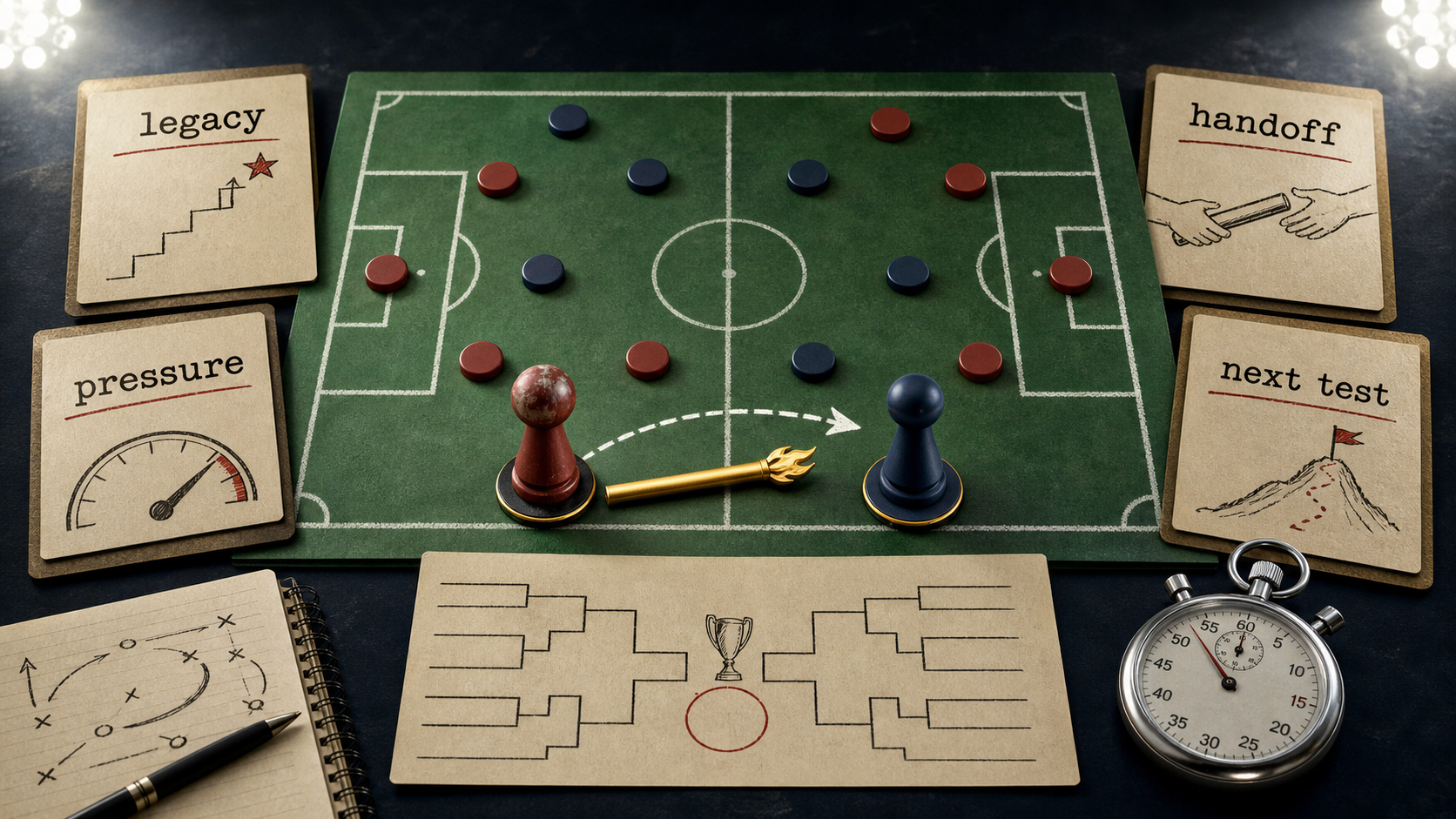
Portugal’s 2-1 comeback over Croatia on July 2, 2026, has the obvious sports hooks: a World Cup knockout match, Cristiano Ronaldo’s first knockout-stage World Cup goal, a late Goncalo Ramos winner, several VAR interruptions, and Spain waiting next.
The sharper Story Draft Lab angle is the handoff. Ronaldo’s penalty pulled Portugal level. Then he was substituted. Ramos, the younger forward who already carries his own Portugal knockout memory from 2022, scored the stoppage-time goal that kept the campaign alive.
That sequence is why the match works as a writing lesson. A legacy story is not only about the veteran finally getting a missing moment. It becomes more emotional when the veteran’s moment creates room for someone else to finish the scene.
Why this trend has traffic energy
The factual hook is easy to understand. The Guardian reported that Portugal came from behind against Croatia, with Ronaldo equalizing from the spot and Ramos scoring late. Al Jazeera’s match report also framed the result around Ronaldo pulling Portugal level, Ramos winning it, and Croatia having a late goal ruled out. FOX’s highlight and Ronaldo-tracking pages reinforced the social-video angle around Ronaldo’s first World Cup knockout goal.
The emotional hook is older than football. Audiences pay attention when a famous figure is running out of time. They pay even more attention when the story refuses to give that figure a simple solo ending.
Ronaldo gets the missing line in the record book. Portugal still needs a substitute to carry the next action. Croatia’s late disallowed goal keeps the ending tense rather than clean. Spain waiting in the next round turns the result into a bridge, not a curtain call.
That is a useful combination for fiction writers: closure, interruption, transfer, and an unfinished next test.
The legacy-handoff engine
Use this pattern when a character’s reputation is too large for an ordinary win.
The handoff is the part that keeps the pattern from becoming nostalgia wallpaper. If the veteran solves everything alone, the audience gets tribute. If the veteran disappears without impact, the audience gets replacement. The more interesting version gives the older character a real beat, then lets the next character prove that the world has not frozen around the legend.
Why the substitution matters
Substitution is a powerful story action because it makes time visible. It says the body has limits, the game keeps moving, and the story has to decide whether it belongs to one icon or a whole group.
In fiction, that can look like:
- A retired detective identifying the clue but letting the new partner make the arrest.
- A queen winning one last political concession before handing the dangerous errand to her heir.
- A famous musician recovering one lost song, then hearing a student perform the version that moves the crowd.
- A warrior breaking the siege line, then watching someone else carry the standard through the gate.
- A founder admitting the company will survive only if another person changes the rulebook.
The key is not to humiliate the older character for drama or worship them so completely that nobody else can act. Let them matter. Then make the next person matter too.
Pair this page with character arc templates when a reputation needs a final test, story stakes ideas when the scene needs public cost, and the USMNT breakthrough story when you want a group-belief version of the same World Cup pressure.
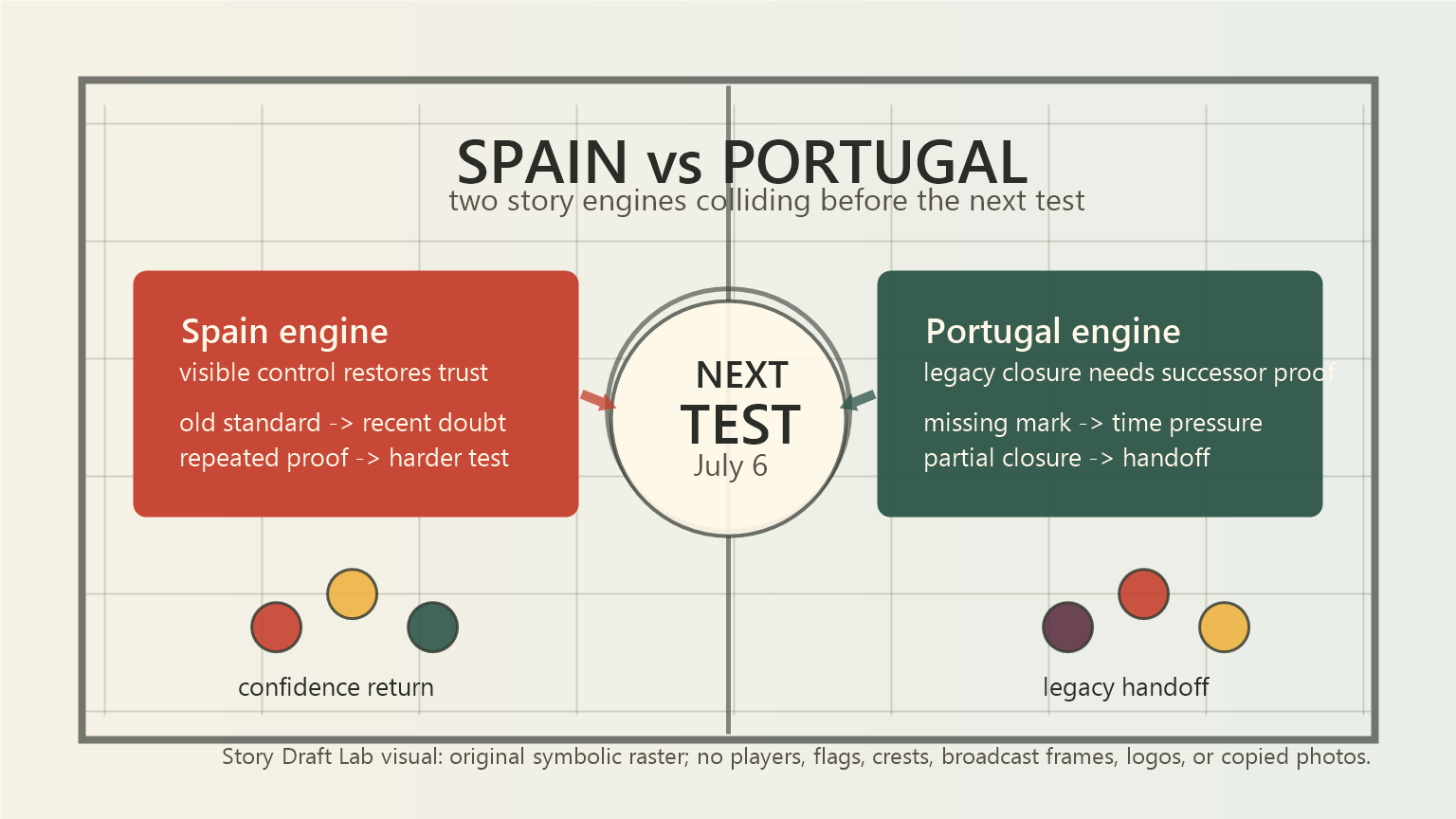
For the July 6 Spain matchup, the sharper contrast is Spain’s confidence-return page. Spain’s story is about a system making control visible again; Portugal’s is about an icon getting partial closure before a successor supplies the finish. Put together, the matchup becomes a useful scene model: restored authority against legacy transfer.
Four scene questions for writers
Ask these before writing a legacy-handoff scene:
- What does the older character still need that cannot be faked?
- Who is watching closely enough for the moment to count?
- What limit forces the veteran to stop before the whole problem is solved?
- What can the successor do that honors the past without merely copying it?
That last question is the difference between inheritance and repetition. A successor who only imitates the icon feels like a weaker version of the same story. A successor who changes the method gives the audience a new reason to lean forward.
Image plan and screening
Chosen image job: explain the match as a symbolic tactics-and-story board about legacy, pressure, handoff, and the next test.
Candidate screening:
- Rejected match photos, wire-service/news images, broadcast stills, highlight thumbnails, real player portraits, Portuguese or Croatian flags, federation crests, FIFA/World Cup marks, sponsor boards, social screenshots, and watermarked images for local use.
- Rejected official video frames because they depend on athlete likenesses, TV composition, platform marks, or uncertain reuse rights.
- Accepted a self-made raster PNG because it is article-specific, symbolic, and non-watermarked. It uses generic red and navy markers, a tactics board, neutral story cards, a bracket card, and a baton-like token. It contains no real athletes, faces, flags, official marks, copied broadcast composition, readable third-party text, or paid-stock preview material.
- Added a second self-made raster PNG for the Spain-Portugal story-engine contrast. It is symbolic, article-matched, and avoids players, flags, crests, FIFA marks, sponsor boards, broadcast frames, logos, watermarks, and third-party photos.
Risks to avoid
Do not write this as prophecy. A legacy arc is not automatically noble because a famous character is old, and a successor is not automatically meaningful because they are young. The audience needs proof that both roles have pressure.
The stronger version gives the veteran one honest piece of closure and gives the successor a decision that cannot be reduced to “stand near greatness.” That is why the Portugal-Croatia sequence is useful as a craft model: the record moment matters, but the winning action belongs to someone else.
Sources
- The Guardian: Portugal beat Croatia 2-1 after Ronaldo penalty and late Ramos winner
- Al Jazeera: Portugal comeback, Ronaldo equalizer, Ramos winner, and late VAR decision
- FOX Sports: tracking Cristiano Ronaldo’s 2026 World Cup goals
- FOX Sports: Portugal vs. Croatia highlights and Ramos stoppage-time goal clip listing
- FIFA: Yamal and Ronaldo help set up Portugal-Spain
- FOX Sports: World Cup roundup with Spain, Portugal, Croatia, and Switzerland