First Draft Checklist
A first draft checklist for finishing a messy manuscript without stopping too early for polish, with a clear handoff into revision.
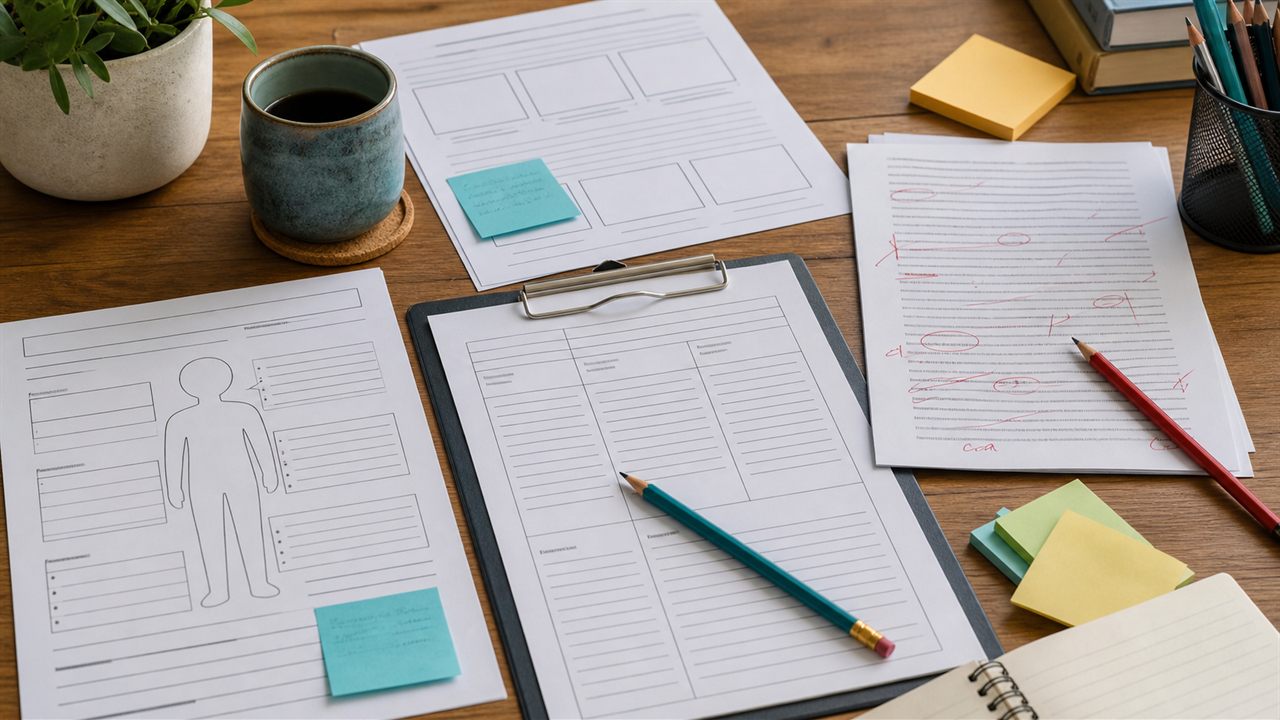
A first draft is allowed to be uneven. Its job is to make the whole story visible enough that revision has something real to work with.
Use this checklist when the manuscript feels rough but almost complete. It is not a line-editing tool. It is a finish-line audit for story movement, missing decisions, and places where the draft can safely stay messy until the next pass.
Pick the version that matches where you actually are
A first draft checklist only helps if the draft is actually a first draft. If the page below is not the right layer for the block in front of you, jump to a more specific page and return here when the manuscript is ready:
- The idea is still in premise form. Run premise test and only draft once the premise sentence passes.
- The idea is drafted but the manuscript is not yet started. Use writing session planner to schedule the first draft before running this checklist.
- The opening is the slow part. Use opening scene ideas to draft a sharp first scene, then return here to finish the rest.
- The whole draft keeps drifting off-rhythm. Use pacing checklist to plan a finish-line rhythm, then return here to keep momentum.
- One scene keeps blocking the draft. Move to scene revision checklist just for that scene so the rest of the manuscript can keep moving.
- Dialogue keeps tripping the draft. Move to dialogue revision checklist for that conversation and come back to the finish-line pass.
- The character keeps changing in summary instead of action. Cross-check with character arc worksheet before sealing the draft.
- The premise keeps losing the deeper question. Use story theme questions to anchor the finish-line scene before drafting.
- A first line would help restart the manuscript. Pick one from writing prompts and use it as the new opening scene.
If the draft is complete except for a flat or uncertain final chapter, do not reopen the entire manuscript yet. Use ending revision questions after this checklist to test whether the last pages answer the story promise through action, cost, and a clear final image.
Finish-line checks
The protagonist makes a choice that starts the main trouble:
The central conflict escalates at least twice:
The middle changes the plan, not just the scenery:
The ending answers the main story question:
At least one relationship changes because of the plot:
The antagonist, obstacle, or pressure has a visible logic:
Allowed mess
Temporary names:
Research gaps:
Scenes that may move later:
Motivation questions to solve in revision:
Continuity problems to mark but not fix today:
Next revision pass
First thing to read for:
Scene most likely to cut:
Scene most likely to expand:
Question to answer before line editing:
Worksheet or checklist to use next:
What to mark, not fix
During a first-draft finish pass, mark problems quickly and keep moving:
- A bracket for research you can verify later.
- A note beside any scene whose purpose is unclear.
- A question beside motivation that changed while drafting.
- A continuity mark where timing, clothing, names, or locations drift.
- A star beside any scene that still feels alive even if the prose is rough.
The point is to preserve momentum without pretending the draft is cleaner than it is.
Completion test
Read the outline of the draft without rewriting sentences. If you can explain what the protagonist wants, what changes the plan, what the final choice costs, and which relationship or belief shifts by the end, the draft is ready for a revision checklist. If the missing answer is mainly in the final chapter, move next to ending revision questions instead of starting a full rewrite. If one of the earlier answers is missing, add the smallest possible bridge scene or decision note before starting polish.
Drafting rule
Do not ask a first draft to be final. Ask it to be complete enough that the next pass can make better decisions.
Handoff into revision
When the finish-line pass is done, the manuscript is ready for the next layer. Pick one of these as the next stop so the draft does not stall on the desk:
- The full manuscript is complete and the structure mostly works. Move directly to revision checklist for the structural pass.
- The pacing drifts but the structure holds. Start with pacing checklist before opening the full revision pass.
- One or two scenes clearly need to be rebuilt first. Run scene revision checklist on those scenes, then return to the full revision pass.
- The dialogue pass is the only unresolved layer. Use dialogue revision checklist before line edits.
- The last chapter is the only weak layer. Move straight to ending revision questions and leave the rest of the manuscript alone for now.
- The character arc does not show up. Cross-check with character arc worksheet before any further revision work.
- The draft exposed a stronger idea. Bring it back to premise test and write the premise sentence for the next draft instead of revising this one further.
Printed-page pass
If you print this checklist, use three marks only: check for complete enough, circle for missing, and star for alive but messy. Too many symbols turn a finish-line checklist into another procrastination device. Craft is noble; color-coded avoidance is still avoidance.