Why a Wimbledon Upset Makes the Crowd Rewrite the Story
A source-backed Story Craft breakdown of Alexandra Eala beating defending champion Iga Swiatek at Wimbledon 2026, and why upsets change audience belief.
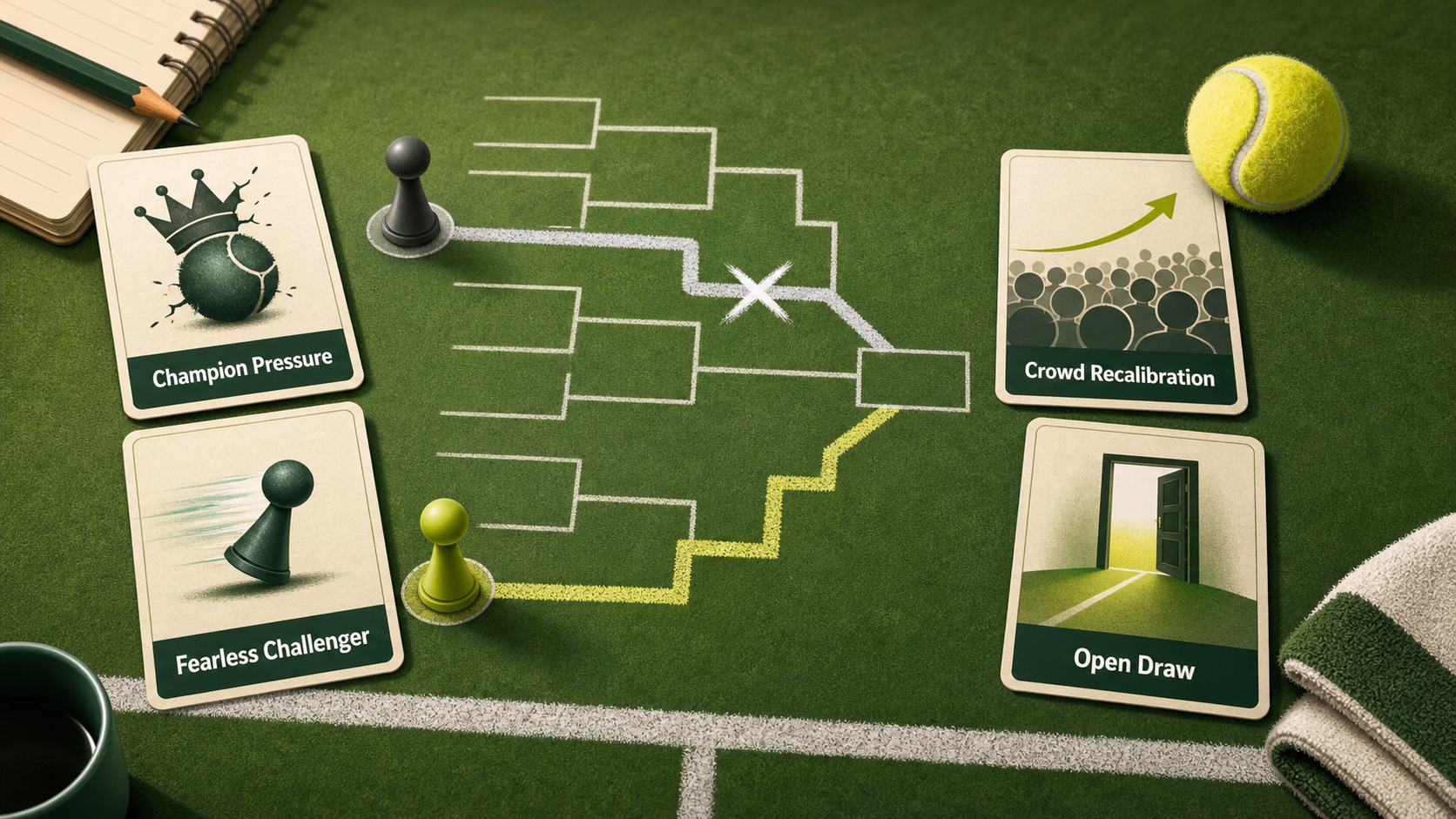
Alexandra Eala’s Wimbledon win over defending champion Iga Swiatek is bigger than a scoreline because it asks the crowd to rewrite the tournament story in real time.
The factual hook is clear. The WTA reported that Eala beat Swiatek in the third round, became the first Filipina to reach the second week of a Grand Slam, and recorded her seventh career Top 10 win. AP coverage put the result at 7-6, 6-2 and emphasized the contrast in background: Eala did not grow up with easy access to grass courts in the Philippines. The Guardian framed the wider day as a draw-shaking one, with Swiatek and Elena Rybakina both exiting in the third round.
The Story Draft Lab angle is audience recalibration. Before an upset, the crowd watches to confirm a known hierarchy. After the upset starts to look possible, the crowd watches to find out whether everyone has been reading the bracket wrong.
Why this trend has traffic energy
This is a strong July 5 traffic lane because it combines a famous tournament, a defending champion, a clean upset score, national-history language, and a newly open draw. It is also easier for general readers to understand than a technical tactics page. “Defending champion loses” is a headline. “First Filipina into the second week of a Grand Slam” is an identity story. “The draw opens” is a suspense engine.
That combination travels because it gives different audiences different emotional entries:
- Fans of the champion experience shock, vulnerability, and the end of an expected route.
- Fans of the challenger experience proof, pride, and sudden permission to imagine more.
- Neutral viewers get the pleasure of a bracket becoming unstable.
- Writers get a clean lesson in how public belief changes during a scene.
The key craft point is that an upset is not only about power changing hands. It is about the audience changing what it thinks is possible before the scene is over.
The belief-shift engine
Use this pattern when a story needs a character to force witnesses to update their assumptions.
This is why upsets are useful in fiction. They let a writer change the emotional weather without adding exposition. A champion’s loss tells the reader that the world is less stable than advertised. A challenger’s win tells the reader that the old hierarchy was real, but not permanent.
Why the champion still matters
The upset only works because Swiatek’s status gives the scene gravity. A random loss does not recalibrate an audience. A defending champion losing early does.
For writers, that means the favorite should not be a straw target. Give the champion visible competence, reputation, ritual, and evidence. Then let the scene ask whether those strengths can survive a new kind of pressure.
That pressure might be:
- A ruler whose old victories no longer solve a new rebellion.
- A senior detective whose methods fail against a younger witness.
- A school champion who discovers the new student is not intimidated by tradition.
- A beloved founder whose company culture stops protecting them from the market.
- A fantasy warrior whose famous technique becomes predictable in front of a prepared rival.
The more earned the champion’s status is, the more meaningful the challenger becomes. The scene is not “the old is bad, the new is good.” It is “the old story was true until another truth arrived.”
Why the challenger changes the room
Eala’s story hook is not only that she won. It is that the result carries first-history language for the Philippines and a background contrast that makes the victory easy to narrate. AP’s detail about limited grass-court access growing up gives the win an immediate story shape: unfamiliar surface, famous stage, established champion, sudden proof.
In fiction, a challenger changes the room when they bring more than confidence. They need a concrete piece of evidence that witnesses can understand.
Use these moves:
- Let the challenger survive an early pressure point instead of winning too easily.
- Give the champion a moment where the old routine almost restores order.
- Show the witnesses changing before anyone says the theme out loud.
- Make the win alter the next room, not just the current one.
- Let pride and uncertainty coexist after the upset.
That last move keeps the story honest. A breakthrough does not erase pressure. It creates a new public self the character must now carry.
Pair this page with the penalty-upset breakdown for witness pressure, the Tour de France team-pressure page for public exposure inside performance, story stakes ideas when the result needs consequences, and character growth prompts when the challenger must become someone new after the win.
Image plan and screening
Chosen image job: a symbolic grass-court bracket board that explains an upset as a belief shift, not a copied sports image.
Candidate screening:
- Image search returned match photos, wire/news images, player portraits, broadcast frames, tournament graphics, social clips, thumbnails, and articles using AFP/AP/Getty-style photography.
- Rejected real-player photos, celebrity likenesses, Wimbledon marks, official tournament graphics, flags, sponsor boards, broadcast frames, social screenshots, watermarks, and paid-stock previews.
- Accepted the generated raster PNG because it is article-specific, symbolic, non-watermarked, and contains no real athletes, faces, official logos, tournament marks, copied court composition, sponsor signage, or third-party imagery.
Risks to avoid
Do not turn the page into a prediction or betting angle. The evergreen value is not whether Eala will keep winning. The useful pattern is how an upset makes witnesses revise status, identity, and possibility.
Also avoid writing the champion as exposed or fraudulent. A stronger story preserves the champion’s earned power while showing that power under new conditions. That is where character pressure lives.
Sources
- WTA: Eala dethrones Swiatek at Wimbledon to make new history for the Philippines
- AP News: Defending champion Iga Swiatek and No. 2 seed Elena Rybakina out
- The Guardian: Swiatek and Rybakina crash out of Wimbledon as Eala and Mertens pull off upsets
- Sportsnet/AP: Defending Wimbledon champion Iga Swiatek loses to Alexandra Eala