Why the Tour de France Team Time Trial Feels Like Collective Suspense
A source-backed Story Craft breakdown of the 2026 Tour de France Grand Depart in Barcelona, the stage 1 team time trial, and why group rhythm creates character pressure.
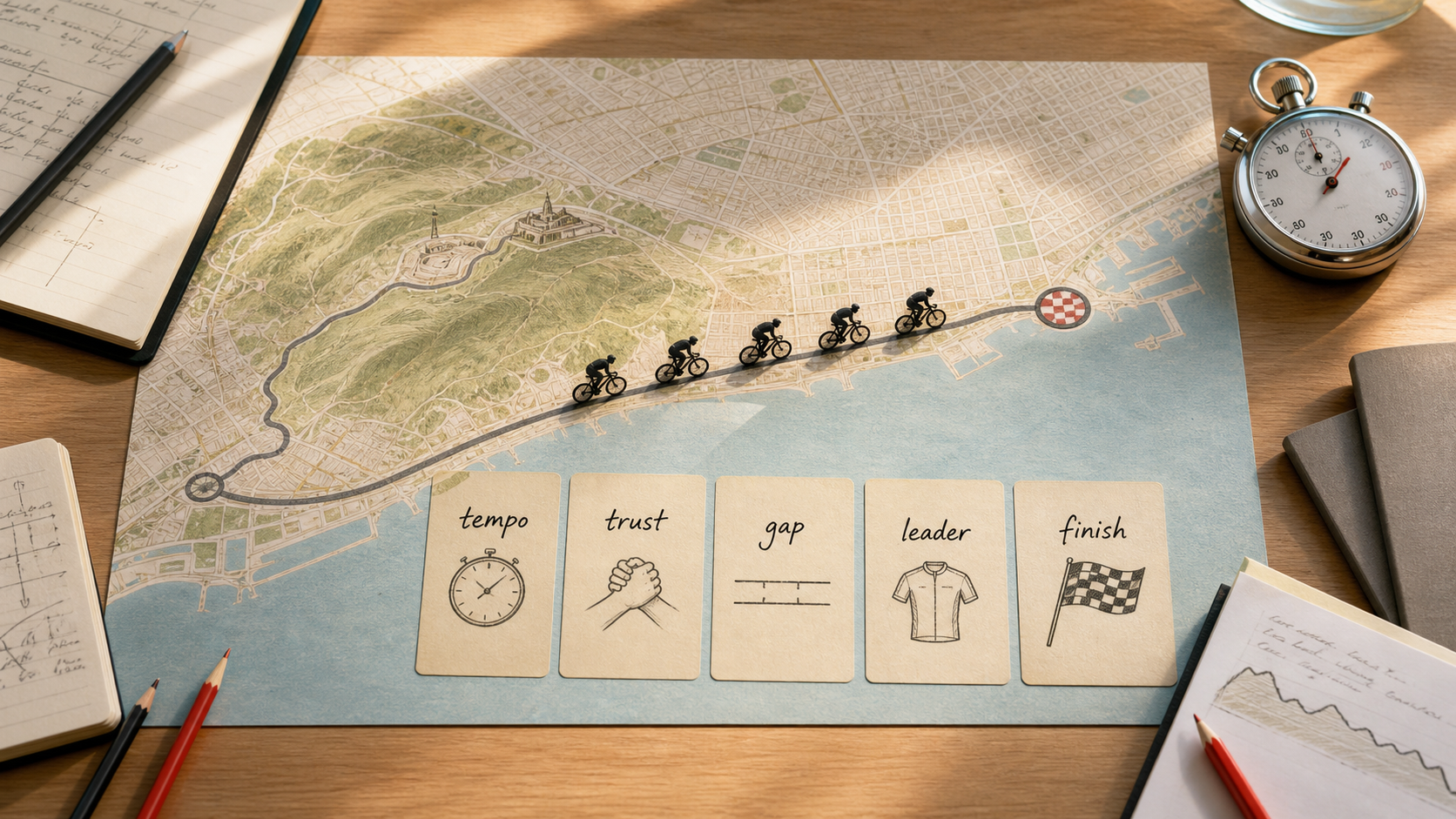
The 2026 Tour de France begins today, July 4, with a Grand Depart in Barcelona and a 19.6 km team time trial. That gives the race a cleaner story hook than a normal opening sprint: before one rider can become the face of the Tour, a whole group has to move as one.
The official race pages list stage 1 as Barcelona to Barcelona, 19.6 km, team time-trial, with about 200 meters of elevation gain. The wider Grand Depart schedule also makes the start feel like a city event, with Barcelona hosting the opening stage before the race moves through Catalonia.
The Story Draft Lab angle is collective suspense. A team time trial looks sleek from a distance, but its emotional engine is fragile: every rider is both protection and threat. Pull too hard and you damage the person behind you. Hide too long and the group loses speed. Drift out of rhythm and the line becomes a visible argument.
Why this trend has traffic energy
The current hook is broad: the Tour starts today, the Grand Depart is outside France, Barcelona gives the opening weekend a recognizable city backdrop, and the first yellow jersey is tied to a discipline casual viewers do not see every week.
Cyclingnews preview coverage framed the opening as a highly anticipated stage 1 team time trial. IDL Pro Cycling’s race preview also treated the format as more than raw strength, noting the need to balance speed, spacing, turns, and not making teammates suffer too much. Official Tour material adds the important twist: this team time trial uses individual times, a format tested at Paris-Nice, so favorites cannot simply hide inside the group.
That rule detail is what turns the page from “cycling preview” into story craft. The group must move together, but each rider’s result can still expose an individual weakness. In fiction terms, it is a perfect pressure device: unity is required, but accountability is personal.
The collective-suspense engine
Use this pattern when a story needs a group to look coordinated while every member is privately under strain.
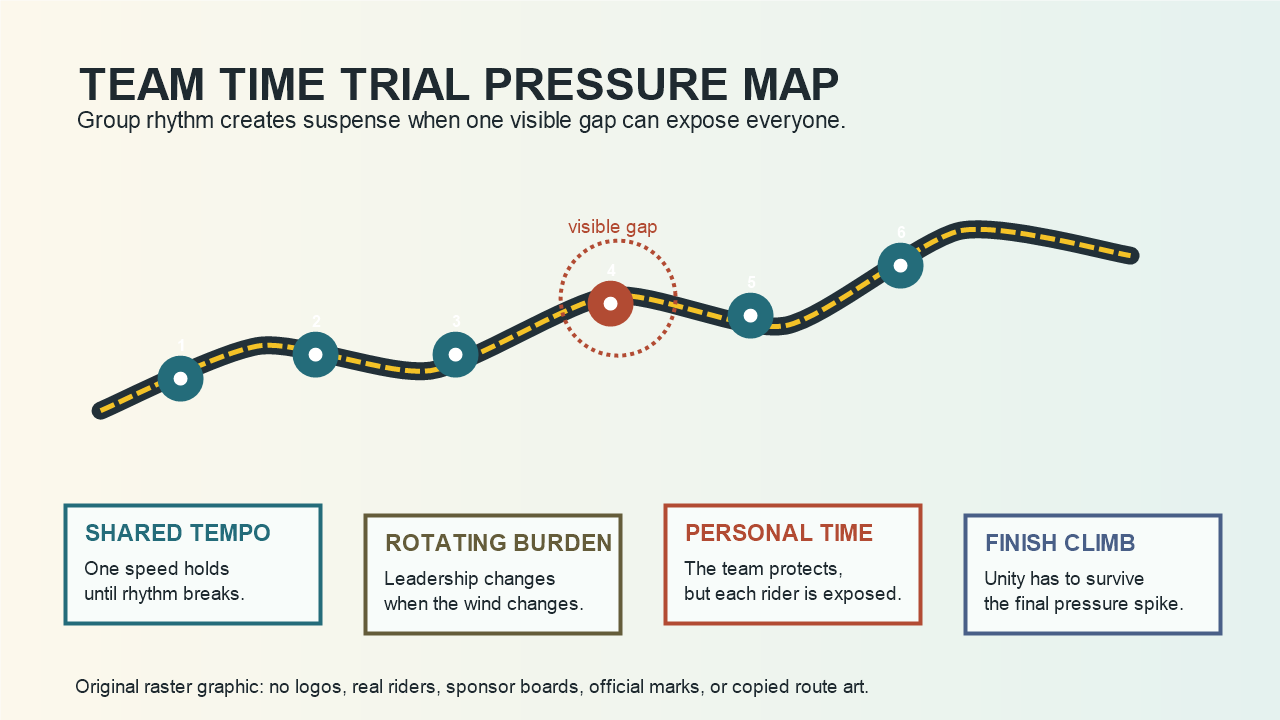
The mistake is writing teamwork as a mood. Good collective suspense needs mechanics. The reader should understand what the group is trying to synchronize, what breaks when one person mistimes a move, and why the fastest character may not be the best leader.
Why the opening format matters
A normal prologue can turn one rider into an instant hero. A team time trial asks a more uncomfortable question: can a favorite receive help without becoming helpless?
That question works in almost any genre:
- A heist crew has to cross a laser corridor at the pace of its slowest member.
- A courtroom team must keep one witness calm while the lead lawyer is tempted to push too hard.
- A spaceship crew loses time whenever one specialist hides a failing system.
- A family business must present one public plan while private loyalties split the room.
- A fantasy quest party can move fast only when the strongest warrior stops treating support as weakness.
The useful scene move is to make the reader feel the line stretching. In a team time trial, that might be a rider leaving a gap after a corner. In fiction, it might be a delayed answer, a missed cue, a lie that forces another character to compensate, or a leader who cannot tell whether pushing harder will save the group or snap it.
Pair this page with story stakes ideas when the group needs public cost, relationship dynamics when trust has to become action, and character motivation ideas when every member needs a private reason to stay in formation.
Four scene questions for writers
Ask these before writing a collective-suspense scene:
- What rhythm does the group have to share: speed, secrecy, timing, etiquette, belief, or risk?
- Which character is strong enough to hurt the group by overhelping?
- Where can the audience see the first gap before anyone admits there is a problem?
- What does each person lose if the group succeeds but they personally crack?
The last question keeps the scene from flattening into a teamwork poster. A good group scene does not erase individual desire. It makes individual desire dangerous at exactly the moment cooperation matters most.
Image plan and screening
Chosen image job: a symbolic Barcelona route-map still life that explains the team time trial as a story board about tempo, trust, gaps, leadership, and finish pressure.
Candidate screening:
- Rejected race photos, wire-service/news images, broadcast frames, official route graphics, sponsor-heavy team imagery, rider portraits, team jerseys, Tour de France marks, city-event logos, social screenshots, watermarked previews, and paid-stock images for local use.
- Rejected image-search candidates from official route/profile graphics and cycling-news pages because they were useful for source context but too close to official map design, sponsor-heavy race imagery, or real-rider/news-photo reuse for a local article asset.
- Rejected direct recreations of official stage maps because they create avoidable rights and accuracy risk.
- Accepted two original raster PNGs because they are article-specific, symbolic, non-watermarked, and avoid real riders, faces, logos, team names, official race marks, flags, sponsor boards, copied route art, and copied news composition.
Risks to avoid
Do not turn the team time trial into a generic “teamwork is good” lesson. The form is more interesting than that. It is about the uneasy overlap between cooperation and exposure.
For writers, the strongest version gives every member a reason to want the group rhythm and a reason to break it. The scene becomes tense when the audience understands that the leader’s job is not simply to go faster. The leader has to know how much pressure the line can carry before someone disappears from it.