Why Enola Holmes 3 Turns a Wedding Into a Mystery Engine
A source-backed Story Craft breakdown of Enola Holmes 3, sequel fatigue, interrupted weddings, missing-family stakes, and how writers can make two promises pull one plot.

Enola Holmes 3 arrived on Netflix on July 1, 2026, giving Story Draft Lab a cleaner afternoon angle than another broad release note: how does a sequel make a familiar character feel urgent again without simply getting louder?
Netflix’s Tudum release page says the third film follows Enola to Malta, where wedding plans unravel when Sherlock disappears and the case pulls personal and professional dreams into conflict. Netflix also promoted the first five minutes on release day, while review coverage immediately split into the two reactions that make sequels searchable: some viewers want the comfort of a returning mystery-romance format, while critics ask whether the franchise is losing momentum.
That tension is the Story Craft angle. A sequel does not only need a new case. It needs a new pressure pattern that forces the audience to ask which promise matters more.
Why this release has a second-angle hook
The morning traffic lane for July 1 was the family-theatrical release of Minions & Monsters. Enola Holmes 3 opens a different lane: streaming viewers, mystery fans, Sherlock-adjacent search traffic, Millie Bobby Brown interest, and a romance-versus-case hook that can be explained without copying plot beats or using official images.
It also has a useful built-in debate. The Guardian’s release-week review argues that the franchise is starting to lose steam, while other preview and listing pages present the new Malta case, wedding interruption, and returning cast as the exact pleasures fans came back for. That split is useful because it reveals the core sequel problem: recognition creates demand, but recognition can also make every move feel expected.
The two-promise engine
An interrupted wedding is not interesting only because it interrupts romance. It works because it creates two promises in the same opening shape.
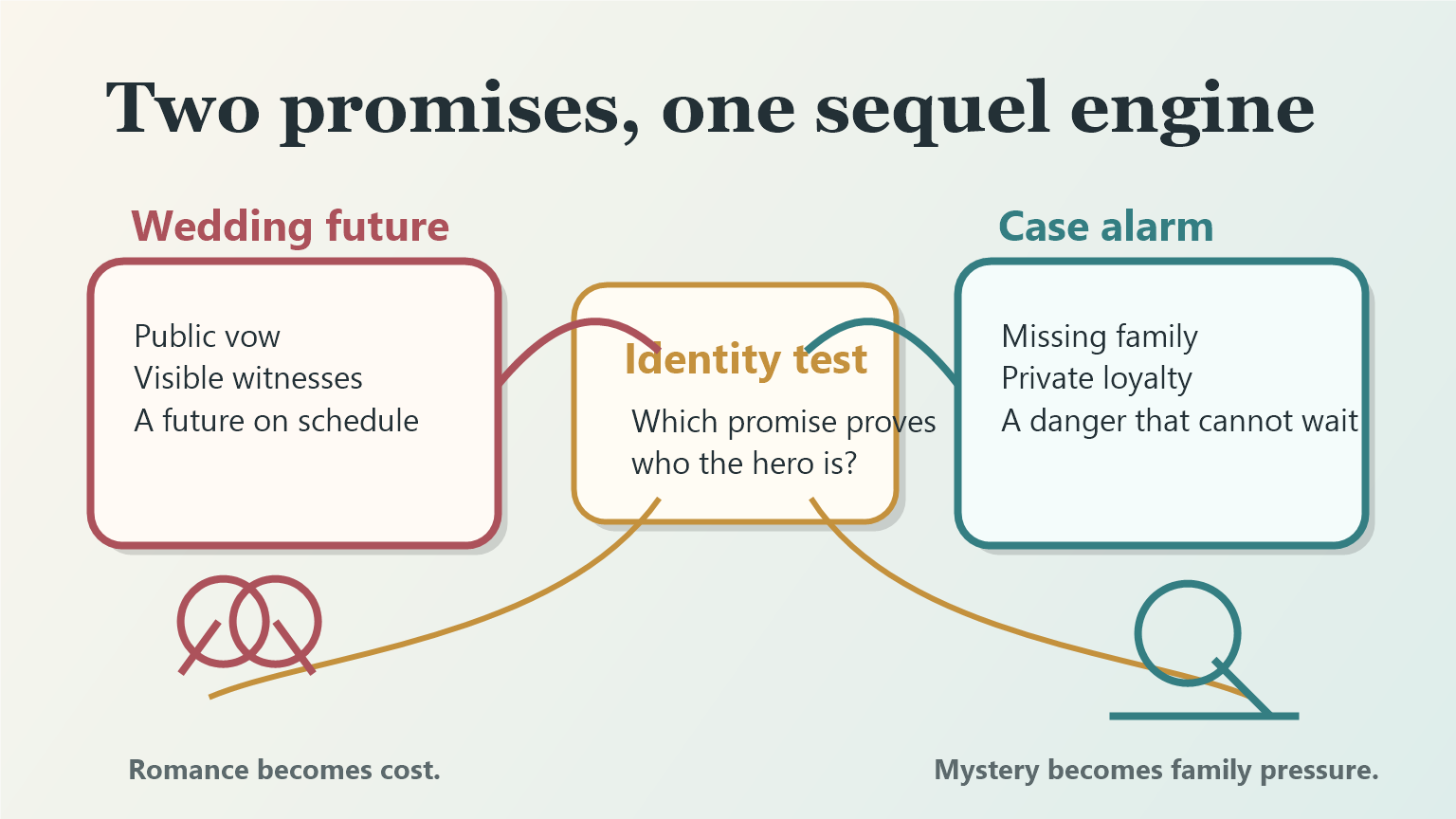
The case matters because it invades a life milestone. The romance matters because it is no longer a decorative subplot; it becomes the thing the case threatens to delay, expose, or redefine.
For writers, this is a useful sequel pattern: put the returning character between two promises the audience already understands. Do not ask whether the character can solve a case in the abstract. Ask what solving it will cost the version of life they were about to choose.
Why missing-family stakes travel
A kidnapped or missing Sherlock is also a smart pressure choice for a franchise built around a younger Holmes. It turns the famous older name from shadow into vulnerability. Instead of using Sherlock only as brand gravity, the setup makes him the absence that reveals Enola’s priorities.
That is a different emotional engine from a puzzle box. A puzzle asks, “What happened?” A missing-family case asks, “Who are you when the person who defines part of your identity is suddenly unavailable?”
This is why the hook travels beyond plot. Viewers can search release time, cast, reviews, and whether the sequel is worth watching. But the story question underneath is more durable: how do you keep a clever protagonist from becoming too comfortable?
What writers can borrow
Use the Enola Holmes 3 pattern when a returning protagonist needs fresh pressure without a total reinvention.
- Give the character a visible life promise before the plot intrudes. A wedding, promotion, journey, audition, trial, public speech, or reunion gives the interruption something concrete to threaten.
- Make the case attack identity, not just schedule. The external problem should pull on the character’s family role, reputation, desire, guilt, or future self-image.
- Let the old skill solve a new cost. If the reader already knows the hero is clever, the question cannot simply be whether they are clever again.
- Use romance as a pressure system, not a reward sticker. The relationship should change what the hero risks, hides, admits, or postpones.
- Watch for sequel fatigue. Familiar beats need sharper consequence, cleaner escalation, or a new emotional contradiction.
Pair this with mystery plot template when the case needs a stronger clue chain, relationship dynamics when romance and loyalty are pulling in different directions, scene planning when an interruption needs witnesses and objects, and story stakes ideas when the external problem needs a personal cost.
Image plan and screening
Chosen image job: show the article’s mechanism, not the franchise surface: a wedding invitation being overtaken by a clue note, red investigation thread, key, clock, and magnifying glass.
Evening upgrade image job: make the two-promise engine scannable before the reader reaches the craft advice. The accepted PNG maps wedding future and case alarm into one identity test, using symbolic rings, a magnifying glass, and abstract cards rather than franchise imagery.
Candidate screening:
- Rejected the official poster, Netflix key art, trailer frames, promo stills, YouTube thumbnails, social screenshots, entertainment-news images, and actor portraits because they rely on copyrighted franchise material, celebrity likenesses, logos, or unclear reuse rights.
- Rejected generic web detective and wedding-invitation images because several came from commercial invitation, game, or event pages with unclear image reuse and sometimes readable personal or product details.
- Selected original generated/self-made PNGs. They are article-specific, raster, non-watermarked, and contain no Netflix marks, title treatment, actor likeness, copied poster composition, book cover, or readable third-party text.
Risks to avoid
The weak version of this setup is an interruption that merely delays the wedding. The stronger version uses the interruption to expose what the wedding means.
If a sequel opens with a ceremony and a disappearance, the audience is really watching a promise collision. One promise says, “I know who I am becoming.” The other says, “Prove who you are when the old world calls.” That is why the hook can work for a detective sequel, a fantasy quest, a sports comeback, or a family drama. The genre changes; the pressure pattern stays useful.
Sources
- Netflix Tudum: Enola Holmes 3 release date, cast, trailer, and July 1 Netflix launch
- Netflix Tudum: first five minutes promoted on July 1 release day
- Netflix Tudum: New on Netflix in July 2026 listing
- The Guardian: release-week review and sequel-fatigue critique
- Decider: release-time and premise coverage for Enola Holmes 3