Why Minions & Monsters Makes Nonsense Language Work
A source-backed Story Craft breakdown of Minions & Monsters, Minionese, viral sound jokes, and how writers can make characters readable without exposition.
Minions & Monsters opens in theaters on July 1, 2026, which makes it a useful hot-topic test for Story Draft Lab: not because the site needs to review a family movie, but because the release puts a strange craft problem in front of a very broad audience. How does a story make characters feel understandable when their most famous language is not really ordinary dialogue?
The official movie site lists the July 1 theatrical release. Entertainment Weekly covered a promotional Minionese singing competition tied to the film, with contestants performing pop songs in the franchise’s nonsense language. Reviews and previews also frame the movie around old-Hollywood and monster-movie play, including silent-film energy, slapstick, and film-history jokes. Put together, the traffic hook is clear: people are searching the new release, sharing the language gag, and recognizing that a tiny sound can carry a huge reaction.
That is the Story Craft angle. Nonsense language works only when the audience has other evidence: gesture, rhythm, object choice, repetition, status, timing, and the emotional reaction of everyone around the character.
Why this release travels
The release has three audience lanes at once. Kids get broad comedy. Parents get a familiar franchise. Film-aware adults get a Hollywood-history wrapper. The Minionese competition adds a fourth lane: a viral sound object that can be clipped, imitated, argued over, and laughed at without needing plot context.
That matters because search interest for a family release is often practical at first: showtimes, streaming date, cast, reviews. A story-craft page needs a different reason to exist. The sharper question is why a character type built on nonsense words can still feel clear enough to travel across languages, ages, and platforms.
The story pattern underneath
Most weak comic characters explain themselves. Stronger comic characters make the room explain them.
If a character says something strange, the audience looks for surrounding evidence. What are they holding? Who is afraid? Who is delighted? Did the music speed up? Did the camera, sentence rhythm, or scene layout tell us that this is a triumph, mistake, threat, flirtation, or escape attempt?
That is why nonsense language can work in visual comedy. It is not meaning-free. It shifts meaning away from dictionary words and into pattern recognition.
For prose writers, the lesson is not to invent unreadable dialogue and hope the reader enjoys it. The useful move is to make nonstandard speech legible through behavior.
Why old-Hollywood framing helps
The old-Hollywood and monster-movie frame is more than a decorative setting. Silent-film comedy already trained audiences to read bodies, props, timing, and consequence. A monster image also gives the scene a simple emotional test: are we scared, delighted, fooled, or pretending not to be scared?
That is a clean reason the topic fits Story Draft Lab. A story world can make communication easier when the rules of performance are visible. A court scene tells readers how to interpret testimony. A school play tells them how to interpret embarrassment. A sports penalty tells them how to interpret pressure. A silent-film stage tells them to read the body before the words.
What writers can borrow
Use the Minions & Monsters pattern when a character’s voice needs to be memorable without becoming exposition.
- Keep invented words short. The more a reader has to decode, the less room they have to feel the joke.
- Put the meaning in the action around the line. The word is the spark; the gesture, object, and consequence are the translation.
- Let other characters react honestly. Laughter, alarm, impatience, tenderness, and confusion all tell the reader how the sound landed.
- Build a repeatable rhythm. A phrase, gesture, or object can become a character signal if it returns at better and worse moments.
- Avoid using nonsense to dodge character work. The audience still needs desire, fear, status, and change.
Pair this with character voice exercises when a cast member sounds too generic, character traits when the behavior needs a clearer pattern, scene planning when a comic beat needs witnesses and objects, and opening scene ideas when you want a character to be readable before they explain themselves.
Image plan and screening
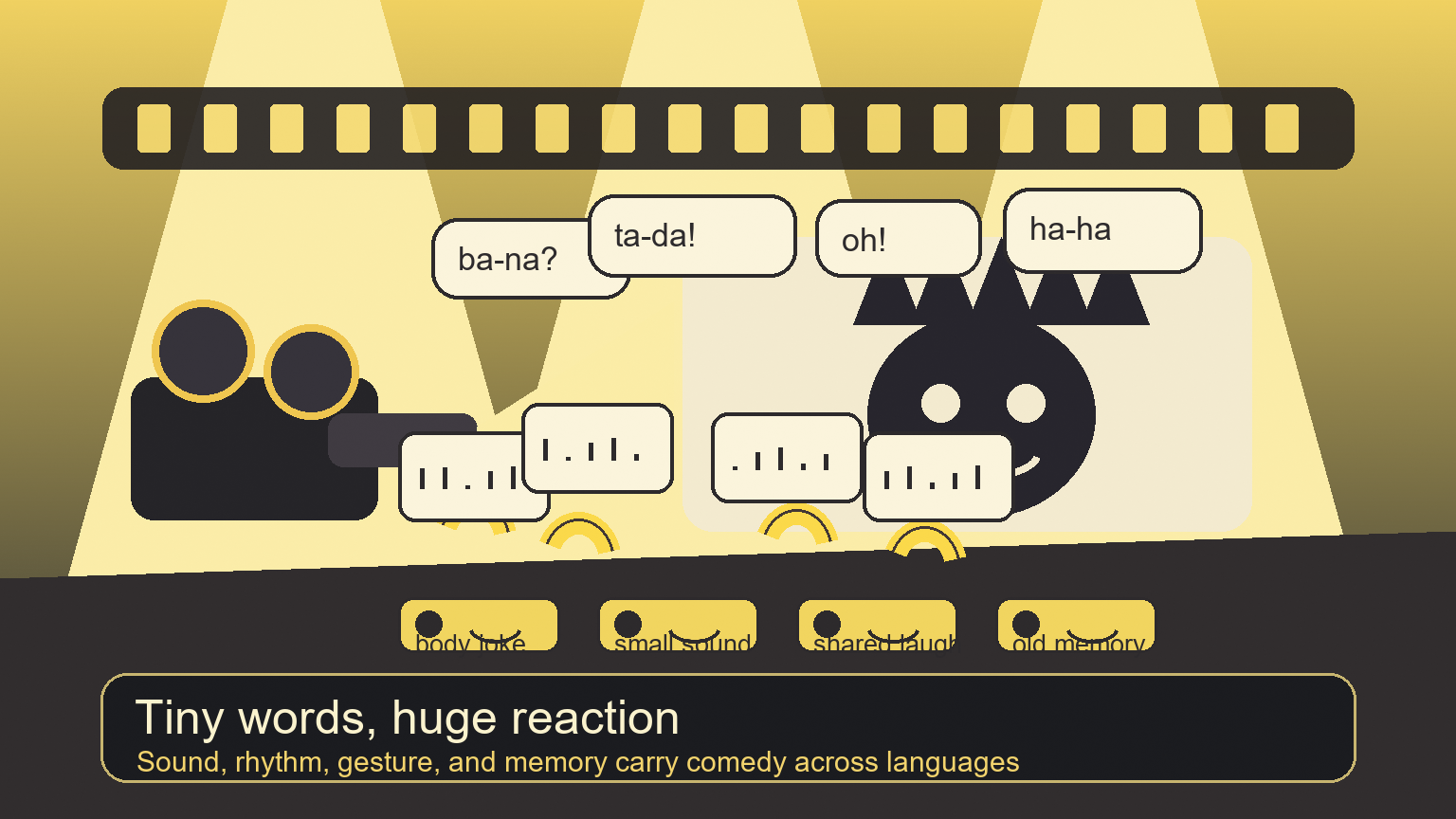
Chosen image job: explain nonsense-language comedy as a safe symbolic stage system: projector, old film strip, monster shadow, speech bubbles, sound cards, gesture cues, and reaction labels.
Candidate screening:
- Rejected official posters, character art, trailer frames, studio logos, YouTube thumbnails, social screenshots, and entertainment-news images because they rely on franchise-owned visuals or unclear reuse rights.
- Rejected direct character likenesses and actor/voice-cast portraits because the page is about the communication mechanism, not a profile or review.
- Selected an original generated/self-made PNG built from generic stage, projector, monster, sound, banana, and reaction-card symbols. It contains no official logo, copied poster, real person, watermarked material, or studio artwork.
Risks to avoid
The cheap version of this pattern is random noise. Random noise can be briefly cute, but it does not sustain a scene unless the audience can infer motive and consequence.
The stronger version treats sound as behavior. A made-up word can reveal impatience, loyalty, panic, pride, desire, or grief if the surrounding scene gives the reader enough evidence. That is the line writers should borrow from a broad family-comedy release: not the surface syllables, but the structure that makes an audience understand before it translates.
Sources
- Official Minions & Monsters site: July 1, 2026 theatrical release and showtimes
- Entertainment Weekly: Minionese singing competition and viral promotional context
- New York Post: review noting old-Hollywood and silent-film framing
- San Francisco Chronicle: review context on early-Hollywood references and cameo discussion
- Deadline: CinemaCon first-look context for Minions & Monsters