Why Sunrise on the Reaping Turns Haymitch Into an Origin-Story Pressure Test
A source-backed Story Craft breakdown of The Hunger Games: Sunrise on the Reaping, young Haymitch, prequel suspense, fan continuity, and how writers can make a known ending feel painful again.
The Hunger Games: Sunrise on the Reaping picked up fresh attention around a new “Meet Haymitch” featurette tied to Haymitch Abernathy’s birthday and Reaping Day in the franchise calendar. Lionsgate’s official YouTube listing frames the film for theaters and IMAX on November 20, 2026, while entertainment coverage is already centering the pressure on Joseph Zada playing the younger version of a role strongly associated with Woody Harrelson.
That is the useful Story Craft angle. A prequel does not create suspense by hiding the ending. It creates suspense by making the audience feel the cost of an ending they already know.
Why this topic is moving now
The immediate hook is simple: a recognizable franchise released a character-focused promotional beat for a prequel about young Haymitch. Search interest naturally gathers around the actor, release date, trailer, cast, and whether the new portrayal can honor the older version fans remember.
The broader hook is stronger. Sunrise on the Reaping is based on Suzanne Collins’ 2025 novel and returns to the Second Quarter Quell, the 50th Hunger Games, with twice the usual number of tributes. That premise gives the page a craft problem rather than only a news item: how do you write a character whose future is already famous?
For Story Draft Lab, the answer sits between backstory, public pressure, and reader psychology.
The known-ending contract
Prequels make a quiet deal with the audience: “You know where this person ends up. Now watch what had to happen for that future to make sense.”
That contract changes the job of every scene. The reader is not only asking whether Haymitch survives. They are asking what survival removes, what it teaches him to distrust, and why later cynicism feels like earned armor instead of a random personality trait.
Why young-Haymitch pressure works
A younger version of a famous character carries two audiences at once. New viewers need a clean human problem. Existing fans need a reason to believe the earlier self can grow into the later one.
That is why tiny continuity gestures become emotionally loud. A line delivery, a posture, a flash of gallows humor, or a refusal to perform fear can feel like proof that the origin belongs to the character. But if the story only imitates the older version, it freezes him. The stronger move is to show the wound before the coping style hardens.
Writers can use this pattern without writing franchise fiction. Start with a known adult flaw, strength, habit, or defense. Then ask what public event made that behavior useful.
The public ritual as story pressure
The Reaping is not just a plot device. It is a public ritual that turns private dread into group emotion. Everyone watches. Everyone understands the rules. Nobody can pretend the outcome is only personal.
That is useful craft architecture. A public ritual creates three pressures at once:
- The selected character has to react while being watched.
- The crowd has to decide whether to grieve, cheer, submit, or look away.
- The system turns randomness into performance, which makes the audience argue about fairness and control.
This is why origin stories often work best when the first wound is witnessed. A private tragedy can explain a character. A public wound can explain a worldview.
What writers can borrow
Use the Sunrise on the Reaping pattern when a backstory needs to feel active rather than explanatory.
- Begin with the future trait readers already know: cynicism, charm, silence, loyalty, rage, caution, humor, ambition, or distrust.
- Build a scene where that trait would become useful under pressure.
- Put witnesses in the room. Public attention makes the reaction harder to hide and easier for readers to remember.
- Make the cost specific. “They survived” is less interesting than what survival trained them to never believe again.
- Avoid over-explaining continuity. Let repeated gestures, choices, objects, and pressure responses create recognition.
Pair this with backstory ideas when a character’s past feels flat, character arc templates when the younger self needs a believable turn, story stakes ideas when survival needs a sharper cost, and quest structure when a known destination still needs escalating tests.
Image plan and screening
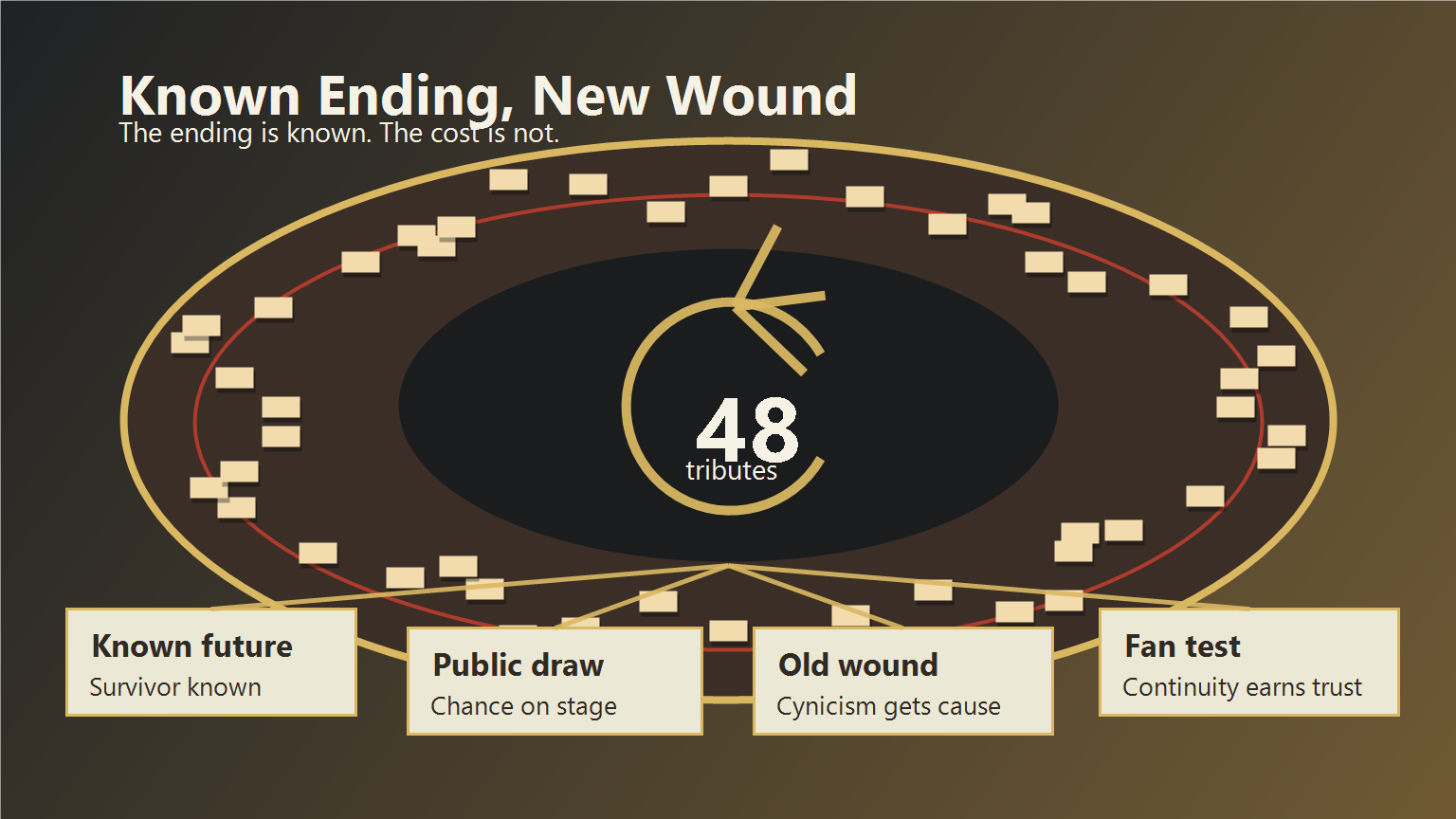
Chosen image job: explain prequel pressure without franchise art. The accepted PNG uses a symbolic arena, forty-eight paper slips, public-draw cards, and a “known ending, new wound” route.
Candidate screening:
- Rejected official posters, trailer frames, YouTube thumbnails, studio images, cast photos, social screenshots, and fan reposts because they rely on copyrighted franchise visuals, actor likenesses, logos, or unclear reuse rights.
- Rejected generic searchable “lottery crowd” images because the best candidates came from unrelated commercial pages with unclear reuse and did not match the Haymitch/prequel angle closely enough.
- Selected an original local raster PNG. It contains no official title treatment, mockingjay mark, actor likeness, book cover, watermarked image, or copied poster composition.
Risks to avoid
The weak version of a prequel treats recognition as enough. It points at a famous future and waits for the audience to care.
The stronger version turns recognition into dread. We care because we can see the future approaching, and because every early choice now has two meanings: what it does in the scene, and what it teaches the character to become later.
That is the lesson for writers. A known ending is not a spoiler if the true suspense is the wound.
Sources
- Lionsgate YouTube: “Meet Haymitch” featurette and November 20 theatrical/IMAX listing
- Deadline: trailer coverage for The Hunger Games: Sunrise on the Reaping
- Rotten Tomatoes: release date, cast, and franchise background roundup
- CinemaBlend: July 2026 featurette reaction and young-Haymitch continuity angle
- Deadline: teaser-view momentum and Lionsgate launch context