Why Silo Season 3 Makes Worldbuilding Feel Like Pressure
A source-backed Story Craft breakdown of Silo season 3, controlled knowledge, split timelines, memory loss, and how writers can make a setting pressure every character.
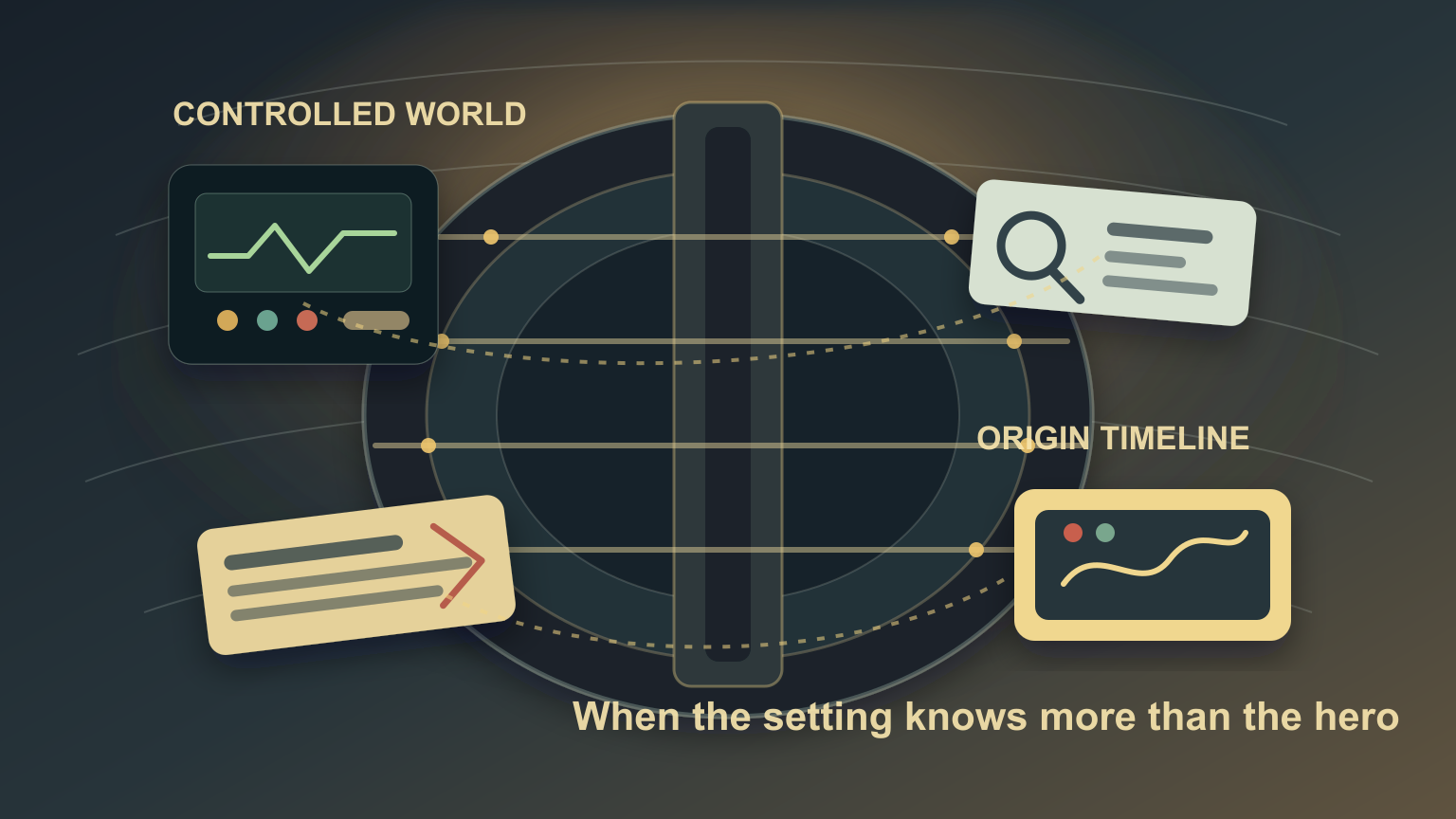
Silo season 3 premieres on Apple TV on July 3, 2026, which makes July 2 the useful pre-release window for a Story Craft angle: why does a worldbuilding show become more gripping when the setting appears to know more than the people living inside it?
Apple’s official season 3 materials confirm the shape of the hook. The 10-episode season starts July 3 and releases weekly through September 4. Apple describes a story that continues the underground present after rebellion and a forced “cleaning,” while also revealing an origin story set centuries earlier. The present-day pressure includes Juliette returning with memory loss; the past follows a journalist and a congressman uncovering a conspiracy with catastrophic consequences.
That is not just plot information. It is a lesson in how a setting can behave like a pressure system.
Why this is today’s stronger non-repeat hook
The sprint already covered the June 30 World Cup cluster and the July 1 entertainment pair of Minions & Monsters and Enola Holmes 3. Silo opens a different traffic lane: prestige streaming, sci-fi mystery, adaptation interest, Apple TV release searches, and worldbuilding questions.
It is also timed cleanly. Review and recap coverage is arriving ahead of the July 3 premiere, and July streaming guides are treating Silo as one of Apple TV’s headline releases for the month. That gives the page a current source-backed hook without repeating the site’s recent sports, comedy-language, or detective-sequel angles.
The craft value is even cleaner: Silo is about architecture, law, memory, screens, rituals, records, and forbidden knowledge. Those are worldbuilding elements, but they do not sit in the background. They decide what characters can believe, what they can prove, and what they are punished for asking.
The setting as an information machine
A weak fictional setting is mostly decoration. It gives the story a map, a weather pattern, a costume vocabulary, or a cool premise. A strong setting controls information.
In Silo, the central question is not only “What is outside?” It is also “Who gets to know what is outside?” That second question is what turns worldbuilding into pressure.
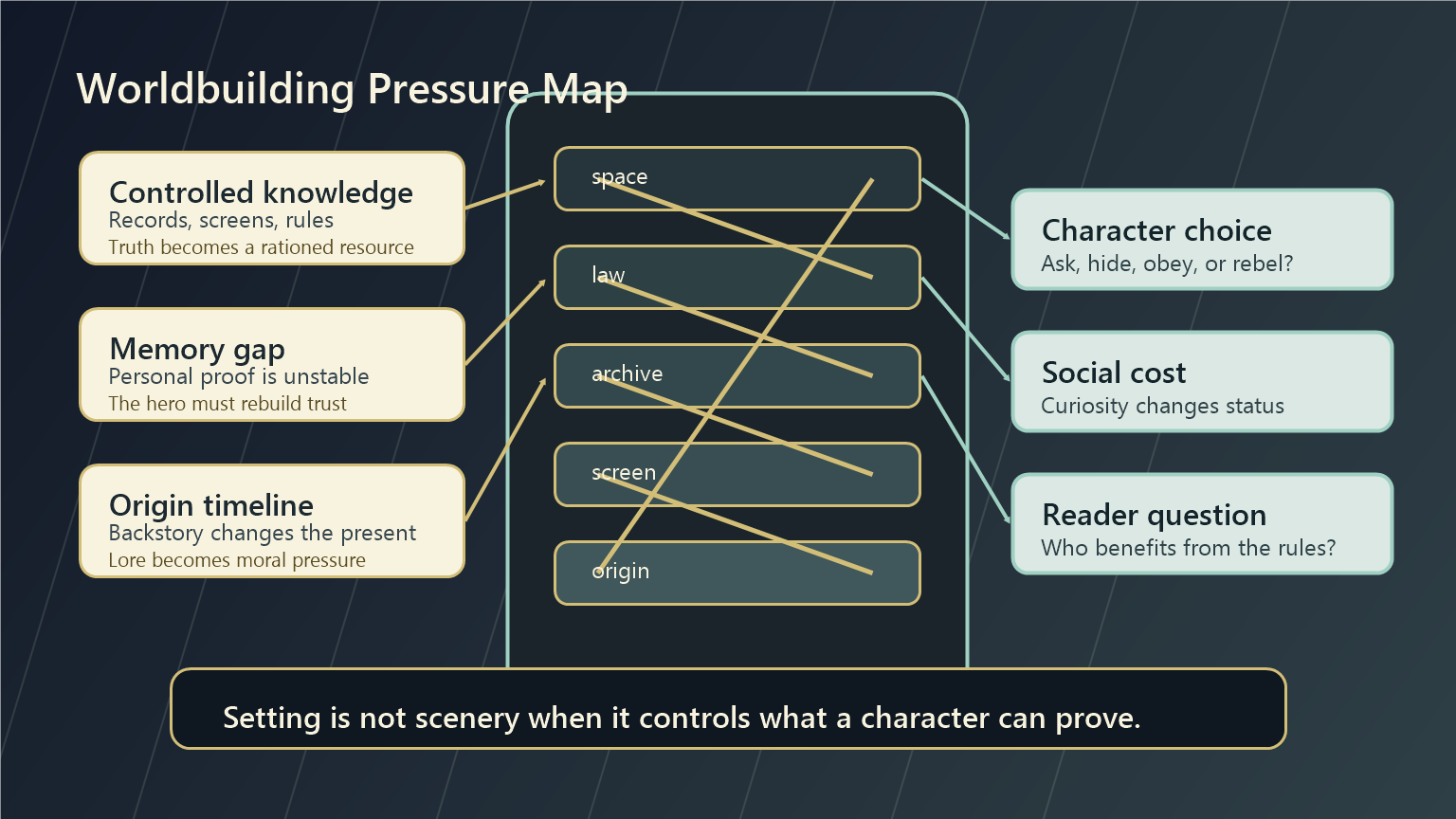
That is why the new season’s split-timeline setup matters. A past timeline can be exposition if it only explains lore. It becomes dramatic when it changes the audience’s emotional relationship to the present: every hallway, rule, screen, and warning may have been designed by people with motives, fear, and political incentives.
The diagram above is the practical version of that idea. Start with the system: what it hides, remembers, records, locks, teaches, or displays. Then force that system to touch character choice. The audience should be able to feel the setting changing what the hero can prove, who will believe them, and what it costs to ask one more question in public.
Memory loss raises the price of discovery
Memory loss can feel cheap when it is used only to delay answers. It becomes stronger when it changes the hero’s bargaining power.
If Juliette returns from outside but lacks reliable access to what happened, the audience is not simply waiting for a missing fact. The character is trying to act inside a society where personal memory, public record, and official explanation may all be in conflict. That is a classic pressure triangle.
For writers, the useful pattern is this:
- Give the character a truth they almost reached.
- Damage, hide, or discredit the evidence.
- Put them back inside a social system that benefits from doubt.
- Make every attempt to recover the truth create a new social cost.
This works in dystopian fiction, but it also works in family drama, mystery, romance, courtroom stories, campus novels, and political fantasy. The specific setting changes. The pressure is the same: the character cannot solve the external plot without first proving which version of reality they are allowed to trust.
Why origin stories are risky
Origin stories have one obvious danger: they can make a mystery smaller. Once the audience sees how the machine was built, the machine may stop feeling uncanny.
The stronger approach is to make the origin story introduce moral pressure instead of merely supplying technical answers. The question should shift from “How did this happen?” to “Who decided this was acceptable?”
That is the useful writing lesson from the season 3 setup. The “Before Times” thread is promising because it can turn worldbuilding into responsibility. Someone made choices. Someone normalized the first compromise. Someone translated fear into architecture, policy, ritual, and silence.
What writers can borrow
Use the Silo pattern when your setting needs to do more than look immersive.
- Treat truth as infrastructure. Decide who controls records, maps, signals, education, archives, passwords, prophecies, or family stories.
- Make the setting punish curiosity in public. Private suspicion is not enough; the character needs a reason asking questions changes their status.
- Let architecture create emotion. Stairs, gates, cameras, walls, levels, neighborhoods, and restricted rooms should alter what characters risk and who can witness them.
- Use a second timeline only when it changes the present. Backstory should sharpen dread, guilt, irony, or urgency.
- Give the hero incomplete evidence. A clue is more interesting when using it might make the character look unstable, disloyal, naive, or dangerous.
Pair this with worldbuilding when the society needs a stronger operating logic, technology level questions when tools and restrictions need rules, setting conflict ideas when place should create friction, character secret ideas when private knowledge needs social cost, and plot twists when a reveal must change more than trivia.
Image plan and screening
Chosen image job: make original raster story-mechanism images rather than reuse Silo publicity material. The hero PNG shows underground levels, a control screen, evidence cards, and an origin-timeline panel. The second PNG maps controlled knowledge, memory gaps, and origin timelines into character choice, social cost, and the reader’s central question.
Candidate screening:
- Rejected official Apple posters, key art, trailer frames, photo-call images, press stills, streaming-service thumbnails, YouTube trailer frames, actor portraits, logos, and entertainment-news images because they rely on copyrighted promotional material, celebrity likenesses, platform marks, or unclear reuse.
- Rejected generic bunker and underground-control-room images from web search because several were portfolio, concept-art, commercial, or editorial images with unclear reuse and too much resemblance risk for a current franchise-adjacent page.
- Accepted the original generated/self-made PNGs because they are article-specific, raster, non-watermarked, symbolic, and contain no Apple marks, actor likenesses, copied poster layout, official silo imagery, book-cover art, or third-party readable text.
Risks to avoid
The weak version of this pattern is lore dumping. The stronger version makes every piece of lore change what a character can do next.
If your world has rules, ask who benefits from them. If it has a map, ask who is forbidden to cross it. If it has a history, ask who edited it. If it has a screen, ask who controls the image. That is when worldbuilding stops being scenery and starts applying pressure.
Sources
- Apple TV Press: season 3 premiere, weekly schedule, cast, origin-story setup, and present-day memory-loss premise
- Apple TV Press: season 3 trailer announcement and July 3 premiere confirmation
- Decider: release-window recap and setup before the season 3 premiere
- Gizmodo: release-week review context for season 3
- Tom’s Guide: July 2026 Apple TV streaming guide highlighting Silo season 3