Why Heartstopper Forever Feels Like a Shared Goodbye
A source-backed trend breakdown of why Heartstopper Forever is built for emotional fandom, fan edits, and finale anxiety, with writing lessons about closure.

Netflix’s Heartstopper Forever is not only another adaptation date on the July calendar. It is a finale built around a rare traffic hook: a fandom that has grown up with the characters now gets a public moment to say goodbye.
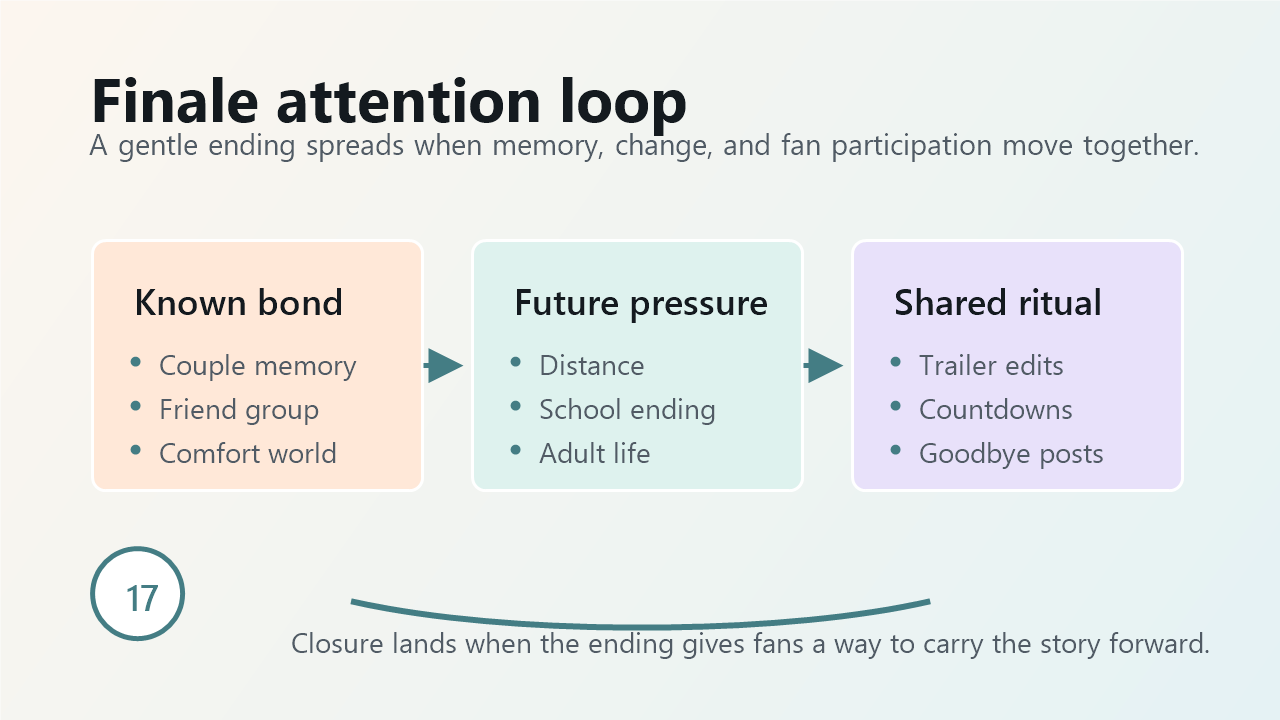
Netflix Tudum says the film debuts July 17 and frames it as the final onscreen chapter for Nick, Charlie, and their friends. The official Netflix page describes the story as a new school year where the relationship deepens and thoughts turn toward life after the last bell. Tudum’s trailer coverage adds a very modern detail: Netflix is making trailer footage available for fan edits, and TechRadar also highlighted that download feature as part of the trailer rollout. The release campaign is not only announcing a finale; it is handing fans material for a goodbye ritual.
That is the useful Story Draft Lab angle. The hot topic is not just “a beloved show is ending.” It is the way a finale lets viewers turn private attachment into shared ritual.
Why this finale travels
Finales travel because they compress many emotions into one search phrase. A casual viewer wants the date. A fan wants reassurance. A lapsed viewer wants to know whether the ending is worth returning for. A writer should notice the structure underneath that demand.
The phrase “final film” does a lot of work. It promises resolution, but it also warns the audience that the comfort object is leaving. That tension is exactly why a sweet story can create anxious attention. People are not only asking what happens to the characters. They are asking what happens to their own routine of caring about them.
The fan-edit signal matters
The trailer-footage invitation is important because fandom now often speaks in clips, edits, reaction captions, and small repeatable moments. TechRadar reported that Netflix provided downloadable trailer files so fans could cut and play with the footage more easily. TikTok has publicly argued that film and TV fandom is a major discovery engine on the platform, citing millions of daily film and TV posts and the role of social video in surfacing old and new titles. MediaPost covered TikTok’s fandom ad push in the same frame: entertainment discovery is no longer separated from remix behavior.
That does not mean every fan edit is marketing. The more interesting point is emotional ownership. When viewers cut a trailer into their own rhythm, they are not merely passing along a message. They are choosing the beat that says, “This is what the story meant to me.”
For a finale, that behavior is especially powerful. The official story ends once. The audience can keep making goodbye versions.
The story pattern underneath
The core mechanic is closure under change. The characters are not facing a giant external villain. They are facing a more relatable pressure: school ends, distance appears, independence grows, and a first-love identity has to survive outside the safe container where it began.
That is why this topic fits Story Draft Lab even though it is entertainment news. It gives writers a clean model for endings that are gentle but still high-stakes. The danger is not only breakup or disappointment. The danger is that growing up will change the meaning of everything the audience found safe.
What writers can borrow
Use the Heartstopper Forever pattern when your story needs an ending that feels communal, not merely conclusive.
- Let the audience know what is ending. A finale lands harder when the reader can name the old world: school, home, summer, first love, a team, a found family, or a season of life.
- Make the future specific. “Everything will change” is vague. University, distance, a new city, a new role, or a new responsibility gives the ending a shape.
- Give the goodbye a ritual. Parties, letters, playlists, packed rooms, last walks, old photos, and repeated gestures let private feeling become visible.
- Reward memory without copying the past. A callback works when it shows growth. If it only points at an old favorite moment, it can feel like a souvenir.
- Leave a believable open door. Closure does not require sealing every future. It requires making the audience trust that life continues off-page.
Pair this with ending ideas when the last act needs more shape, relationship dynamics when the bond needs more pressure, and character growth prompts when a soft ending still needs visible change. If the farewell needs a concrete scene, use the scene planning worksheet to give the goodbye a setting, object, witness, and decision.
Visual plan and image screening
Use original generated or self-made raster visuals only. Do not copy Netflix stills, trailer frames, posters, actor portraits, book covers, official logos, fan-edit clips, watermarked images, or paid-stock previews into the repo.
Chosen image job: explain the emotional mechanics of a finale through safe symbolic objects: a July 17 calendar, friendship bracelets, a blank notebook, and notes for goodbye, distance, memory, and next chapter.
Screened-out candidates and source types:
- Official Netflix/Tudum photos and trailer frames: strong content match, but rejected as local article art because they contain show imagery, actors, and platform-owned promotional assets.
- YouTube trailer thumbnails and social screenshots: rejected because they are brand/platform captures and can contain copyrighted footage.
- Ordinary entertainment-news images: rejected because reuse rights were unclear and many repeat the same official stills.
- Generated raster still life: selected because it is original, article-specific, non-branded, and directly matches the finale-closure analysis.
- Original raster attention-loop diagram: selected because it explains the article’s current-search angle without using actor likenesses, Netflix branding, official footage, or SVG as final article art.
- Fan-edit relay component: selected because it ties the specific trailer-download claim to a reusable story-discovery loop without copying video, screenshots, actor likenesses, or platform UI.
Risks to avoid
The cheap version of a finale is pure nostalgia. It shows the old gestures, asks the audience to feel something, and forgets to test what those gestures mean now. The stronger version lets memory and change argue with each other.
There is also a tone risk. A fan-favorite farewell can become manipulative if every beat begs for tears. The cleaner move is to make the situation honest: people can love each other and still face distance, uncertainty, and different futures. That gives the audience room to feel without being cornered.
For current coverage, stay away from actor gossip, private-life speculation, or copied recap. The useful angle is audience psychology: why a gentle coming-of-age finale can produce big public emotion.
Sources
- Netflix Tudum: Heartstopper Forever plot, date, creator comments, and fan-edit materials
- Netflix Tudum: Heartstopper Forever trailer and July 17 release note
- Netflix Tudum: June 17 trailer roundup and finale framing
- Netflix official title page for Heartstopper Forever
- TechRadar: Heartstopper Forever trailer and fan-edit download feature
- TikTok Newsroom: film, TV, and BookTok fandom discovery context
- MediaPost: TikTok fandom ads for film and book lovers